



Introduction
The rise of generative AI in financial services is accelerating structural changes across banking, fintech, and investment operations. What began as experimental deployment of machine learning models is now transitioning into enterprise-wide integration across core financial systems.
Generative AI in financial services is increasingly being used to automate operational workflows, enhance customer engagement, and improve risk analytics. According to industry participants and cloud service providers, adoption has moved beyond pilot programs into production environments across multiple regions, signaling a broader shift in how financial institutions manage data and decision-making.
The implications extend across retail banking, wealth management, compliance functions, and market analysis, as institutions reassess how artificial intelligence can be embedded into both front-end customer services and back-end infrastructure.
What Is Generative AI in Financial Services?
Generative AI refers to artificial intelligence systems capable of producing text, insights, predictions, and structured outputs based on large-scale data inputs. In financial services, these systems are applied to banking operations, customer interaction tools, and analytical workflows.
Unlike traditional automation tools that execute predefined rules, generative AI systems can interpret natural language, analyze unstructured datasets, and generate context-aware outputs.
Financial industry applications typically include:
- Automated report generation
- Customer service chat interfaces
- Fraud detection modeling support
- Financial forecasting and scenario simulation
- Compliance documentation assistance
Industry reports suggest that financial institutions are among the earliest adopters of enterprise AI tools due to the sector’s high reliance on structured and unstructured data processing.
How Generative AI in Financial Services Works
Generative AI systems in banking environments typically operate through cloud-based infrastructure, where large language models and machine learning systems process financial data in real time.
Data ingestion and processing
Banks and fintech firms feed structured and unstructured datasets into AI systems, including:
- Transaction records
- Market data feeds
- Regulatory filings
- Customer interaction logs
- Macroeconomic indicators
These inputs are processed using large-scale AI models hosted on cloud platforms.
Model execution and output generation
Once trained or fine-tuned, generative AI models can:
- Summarize financial reports
- Generate risk assessments
- Provide customer responses through virtual assistants
- Identify anomalies in transaction flows
- Support investment analysis workflows
Cloud computing providers, including major enterprise platforms, play a central role in enabling scalable AI deployment across financial institutions.
Key Drivers Behind AI Adoption in Financial Services
Operational efficiency and automation
Financial institutions are increasingly using generative AI to automate repetitive tasks such as data entry, compliance checks, and reporting workflows. This reduces manual processing time and reallocates human resources toward higher-value analytical functions.
Customer experience transformation
Generative AI enables personalized customer interactions through chat-based assistants and automated advisory tools. These systems can respond in real time to customer queries and tailor recommendations based on behavioral and transactional data.
Data-driven decision-making
Financial organizations are leveraging AI to interpret large datasets more efficiently. This includes identifying trends in transaction flows, analyzing market sentiment, and improving forecasting accuracy.
According to industry participants in cloud computing and fintech infrastructure, AI adoption has accelerated significantly as institutions integrate these tools into production environments rather than limiting them to experimentation.
Applications of Generative AI Across Financial Services
Banking operations and customer service
Generative AI is being deployed in retail banking to support:
- 24/7 customer service automation
- Digital onboarding processes
- Personalized financial insights
- Internal reporting systems
Virtual assistants and chatbots are increasingly used to manage routine inquiries and improve service availability across digital platforms.
Risk management and compliance
Risk modeling is one of the most significant use cases for generative AI. Financial institutions use AI systems to:
- Analyze transaction anomalies
- Support fraud detection frameworks
- Assist regulatory compliance reporting
- Simulate stress-testing scenarios
These systems can process large volumes of data to identify potential risk exposures more efficiently than traditional methods.
Market analysis and investment strategy
In investment banking and wealth management, generative AI is used to analyze:
- Financial news flows
- Corporate filings
- Economic indicators
- Historical trading patterns
This allows institutions to develop scenario-based forecasts and enhance portfolio construction strategies.
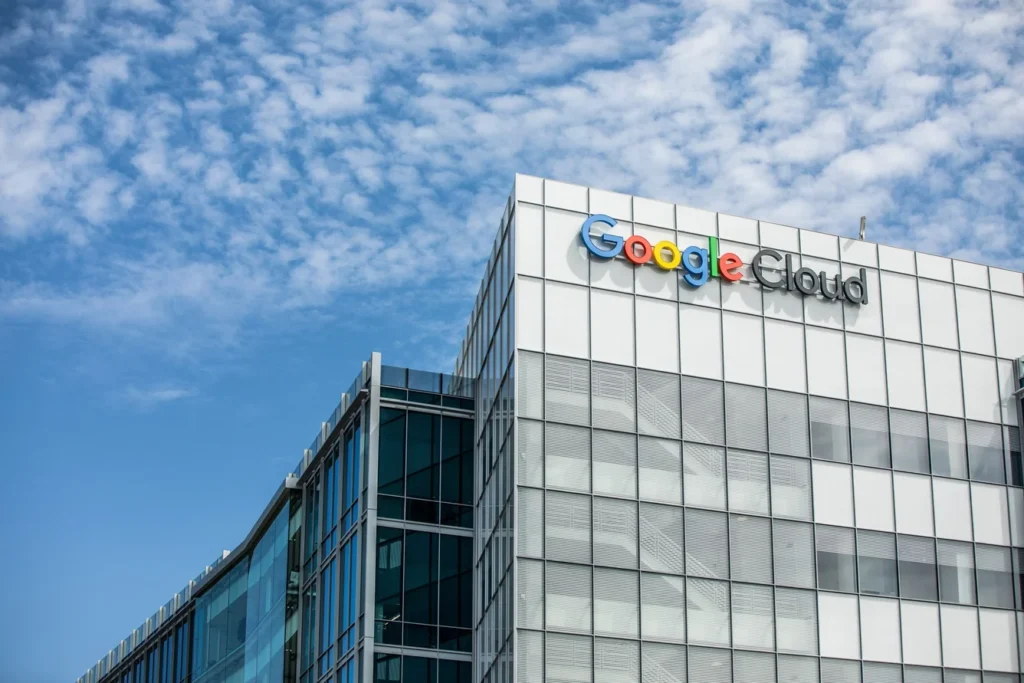
Role of Cloud Providers in AI Financial Infrastructure
Cloud service providers have become central to the deployment of generative AI in financial services. Their infrastructure supports:
- Scalable computing power for AI models
- Secure data storage and processing
- Integration with legacy banking systems
- Deployment of machine learning pipelines
Industry participants, including major cloud platforms, have highlighted financial services as one of the fastest-growing sectors for AI adoption. Research cited within the industry indicates that a significant proportion of financial institutions are already implementing generative AI solutions in production environments.
Risks, Regulatory Considerations, and Limitations
Data security and privacy risks
The use of generative AI introduces additional cybersecurity considerations. Financial institutions must ensure that sensitive customer data is protected across AI training and deployment environments.
Model transparency and explainability
Regulators in multiple jurisdictions continue to evaluate how AI-driven decisions are made within financial systems. A key concern is the explainability of outputs generated by complex machine learning models.
Regulatory compliance frameworks
Financial regulators, including central banks and supervisory authorities, are assessing how AI systems align with existing compliance structures. This includes governance of automated decision-making and accountability mechanisms.
Operational dependency risks
As AI systems become more embedded in financial infrastructure, institutions may face increased dependency on third-party cloud providers and AI model ecosystems.
Future Outlook for Generative AI in Financial Services
The development of generative AI in financial services is expected to continue focusing on deeper integration into core banking systems rather than standalone applications.
Emerging trends include:
- Expansion of AI-driven financial advisory systems
- Greater use of natural language interfaces for banking operations
- Increased integration between AI tools and regulatory reporting systems
- Broader deployment of real-time risk monitoring models
Industry discussions also indicate ongoing evaluation of governance frameworks to balance innovation with regulatory oversight.
Rather than replacing human decision-making entirely, generative AI is increasingly positioned as a support layer for financial analysis, customer engagement, and operational efficiency.
Conclusion
Generative AI is becoming a foundational component of financial services infrastructure. Its application spans customer service automation, risk management, market analysis, and operational efficiency.
While adoption continues to expand, financial institutions are also navigating regulatory, security, and governance challenges associated with large-scale AI deployment. The trajectory of generative AI in the sector is therefore defined not only by technological capability but also by institutional readiness and regulatory alignment.

