


Introduction
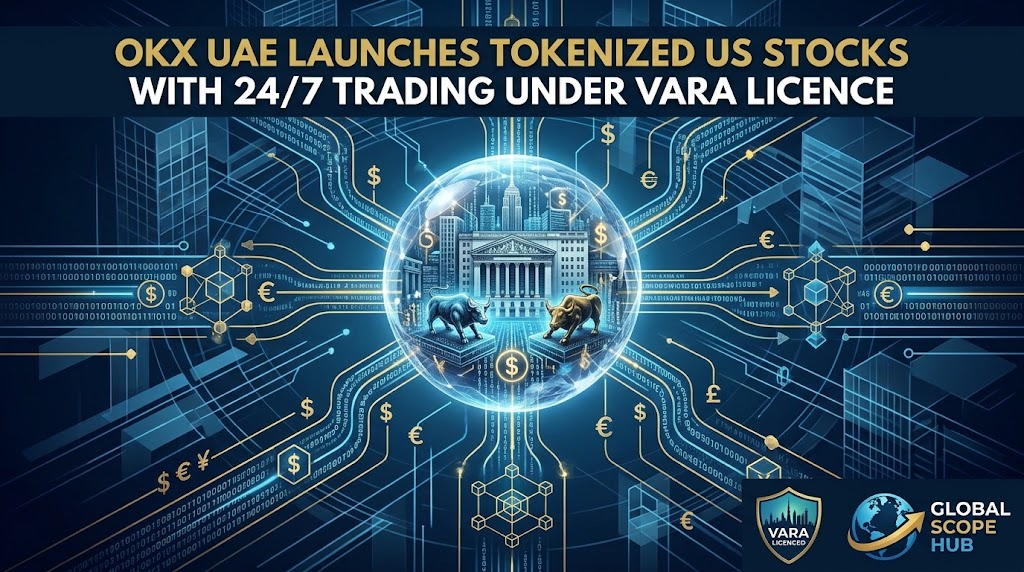
OKX UAE has launched more than 80 tokenized US stocks for eligible UAE users, extending its digital-asset platform into equity-linked products. The service became available on 12 October 2026 and allows users to trade stock-linked exposure around the clock, including weekends and periods when US exchanges are closed. UAE Fintech
The launch places tokenized equities within the same OKX environment used for digital assets. Users can obtain fractional exposure, trade against supported digital currencies and, in Simple mode, purchase supported products directly with AED. OKX says UAE customers can also deposit and withdraw AED through connected UAE bank accounts without fees. OKX
The development is part of a wider expansion of real-world asset tokenization, in which blockchain infrastructure is being used to represent economic exposure to traditional financial assets. For UAE investors, however, an important distinction remains: tokenized stock exposure is not the same as direct ownership of the underlying US-listed shares. OKX
What Are OKX’s Tokenized US Stocks?
OKX describes its Unified Tokenized Stocks as spot digital assets that provide economic exposure to the price performance of an underlying stock or exchange-traded fund.
The products are displayed in share-equivalent units, with an X added to the relevant ticker. For example, a tokenized Apple exposure can be displayed as xAAPL. OKX currently supports xStocks issued by third-party providers, rather than issuing the underlying tokenized assets itself. OKX
The structure is important because purchasing a Unified Tokenized Stock does not make the user a shareholder in the underlying company.
Token holders generally do not receive direct shareholder rights, such as voting rights. Instead, the product provides contractual economic exposure under the applicable OKX and issuer arrangements. OKX
This distinction separates tokenized equity products from conventional brokerage accounts holding actual shares.
How 24/7 Tokenized Stock Trading Works
Traditional US equity markets operate according to exchange trading schedules. OKX’s tokenized-stock markets can operate continuously, including weekends and periods outside conventional Wall Street hours.
That does not mean the underlying US stock exchange is open continuously.
Instead, the tokenized product has its own market and pricing mechanisms. OKX warns that prices can diverge from the underlying equity’s last traded price when US markets are closed, particularly during weekends and other off-hours periods. ytvvbqztr.com
Fractional exposure
Users can build fractional positions rather than acquiring a full conventional share.
This allows the platform to represent stock-linked exposure in smaller units, subject to applicable minimum trade requirements and product terms.
AED funding
The UAE launch also integrates local currency funding. OKX says eligible users can connect a UAE bank account and deposit or withdraw AED near instantly, with zero fees on those AED transactions. UAE Fintech
The combination of AED funding, crypto assets and tokenized equities places several asset types within the same account infrastructure.
Trading outside US market hours
The 24/7 model creates additional trading availability but also introduces a pricing consideration that does not exist in the same form during normal exchange hours.
OKX’s risk disclosures state that off-hours liquidity may be limited and that quoted prices can differ materially from the last traded price of the underlying US equity. ytvvbqztr.com
Why Tokenized Stocks Matter for the UAE Fintech Market
The launch adds another layer to the UAE’s developing digital-finance ecosystem.

OKX Middle East Fintech FZE is licensed and regulated by Dubai’s Virtual Assets Regulatory Authority (VARA) under licence reference VL/23/12/003. The licence was issued on 17 September 2024, according to OKX’s regulatory disclosure. Btmzhjpdgxc
The company is authorised for several virtual-asset activities, including exchange, broker-dealer and management and investment services, subject to the conditions attached to its VARA permissions. Btmzhjpdgxc
The tokenized-stock product, however, should not be interpreted as equivalent to a conventional UAE brokerage service offering direct ownership of US securities. OKX’s own terms distinguish Unified Tokenized Stocks from the underlying equities and state that regulatory classification can vary by jurisdiction. tqyyoncxv.com
That distinction is particularly relevant as financial platforms increasingly combine virtual assets with traditional-market exposure.
Tokenized Stocks Versus Traditional US Shares
| Feature | Tokenized stock on OKX | Conventional US share |
|---|---|---|
| Market access | 24/7 tokenized market | Exchange trading hours |
| Ownership | Economic exposure under product terms | Direct share ownership through a broker/custodian |
| Fractional exposure | Available | Depends on broker |
| Voting rights | Generally not provided | Available to shareholders where applicable |
| Weekend trading | Available | US exchanges closed |
| Pricing | Separate tokenized market and pricing mechanisms | Exchange price |
| Infrastructure | Digital-asset platform and tokenization framework | Securities-market infrastructure |
The comparison is important because the term “tokenized stock” can otherwise imply that the user owns the same legal instrument as a shareholder.
OKX explicitly states that Unified Tokenized Stocks do not represent ownership of, or a direct legal claim against, the underlying equity. tqyyoncxv.com
Regulatory and Market Context
Tokenized equities sit at the intersection of securities regulation, digital assets and financial-market infrastructure.
The European Union’s MiCA framework, for example, does not simply place all tokenized financial instruments within the same regulatory category. Tokenized securities can fall under existing securities-market rules rather than being treated as ordinary crypto-assets.
The distinction is also visible in OKX’s own product documentation. Its Unified Tokenized Stock terms state that the products are offered to eligible non-US users under Regulation S of the US Securities Act and are not registered under the US Securities Act or US state securities laws. tqyyoncxv.com
The US market is simultaneously developing its own tokenization framework. In October 2026, Reuters reported that OKXICE, a joint venture between OKX and Intercontinental Exchange, submitted a filing to the US Securities and Exchange Commission seeking approval for a blockchain-based tokenized securities trading platform offering 24/7 trading of US stocks. Reuters
These developments illustrate that tokenized securities are becoming a regulatory issue across multiple financial centres rather than solely a cryptocurrency-market development.
Costs, Liquidity and Other Implications
The headline benefit of 24/7 access comes with additional market-structure considerations.
OKX’s terms identify several risks, including liquidity risk, tracking differences, issuer risk, blockchain risk and regulatory risk. The company also warns that spreads can widen when US equity markets are closed because pricing may rely on market-maker estimates and other reference information. ytvvbqztr.com
There can also be costs associated with the underlying tokenized instruments. OKX’s terms state that some underlying tokens may carry an annual management fee set by the issuer, with the applicable mechanism potentially reducing the multiplier used to represent share-equivalent quantities. tqyyoncxv.com
Consequently, 24/7 availability should not be interpreted as guaranteeing continuous liquidity or price parity with the underlying US equity.
Risks and Limitations
No direct shareholder rights
The most fundamental limitation is that tokenized stock exposure does not automatically provide ownership rights in the underlying company. Users generally do not receive voting rights or a direct legal claim against the underlying shares. OKX
Off-hours price divergence
Because the underlying US exchanges close overnight, on weekends and on US market holidays, tokenized products can trade at prices that differ materially from the last available exchange price. ytvvbqztr.com
Issuer and counterparty risk
The structure depends on third-party issuers and custodial arrangements. OKX’s documentation says the underlying shares are held by a third-party custodian engaged by the applicable issuer and notes that the issuer may, where permitted, lend those shares. tqyyoncxv.com

Blockchain and technology risk
Where the underlying token operates on blockchain infrastructure, smart-contract failures, network disruptions or other technical events can affect access to the underlying tokenized instrument. ytvvbqztr.com
Regulatory risk
The legal status and availability of tokenized products can change as regulators develop rules for digital representations of traditional financial assets. OKX states that services may be restricted or discontinued where required by applicable law or regulation. tqyyoncxv.com
Future Outlook for Tokenized US Stocks in the UAE
The UAE launch adds to a broader international movement toward combining blockchain infrastructure with traditional financial markets.
OKX had already expanded its unified tokenized-stock offering to more than 40 tokenized US stocks and ETFs in July 2026, with customers in MENA and other regions among the eligible markets. The later UAE rollout increased the offering to more than 80 tokenized stocks. OKX
The parallel development of tokenized securities infrastructure in the United States also suggests that market participants are examining whether blockchain can support continuous trading, settlement and distribution of traditional financial exposures. Reuters reported in October 2026 that the OKX-ICE venture was seeking regulatory approval for its own tokenized securities venue. Reuters
For the UAE market, the important questions will include how tokenized equity products interact with conventional brokerage services, how liquidity develops outside US trading hours, and how regulators address the distinction between virtual-asset infrastructure and securities ownership.
Conclusion
OKX UAE’s launch of more than 80 tokenized US stocks expands the range of financial exposures available through a Dubai-regulated digital-asset platform. The service provides eligible users with fractional, stock-linked exposure and 24/7 trading, including periods when US equity exchanges are closed. UAE Fintech
The product nevertheless differs materially from conventional share ownership. Users receive economic exposure under specific contractual and issuer arrangements rather than direct shareholder rights. Off-hours pricing, liquidity, issuer structure, regulatory status and blockchain infrastructure introduce additional considerations that do not apply in exactly the same way to conventional equities.
The launch therefore represents both a fintech development and a test of how UAE-regulated digital-asset infrastructure can connect users with global financial markets while maintaining clear distinctions between tokenized exposure and traditional securities ownership.

