



SpaceX, the aerospace, satellite connectivity, and artificial intelligence company founded by Elon Musk, has been added to prominent index funds managed by Vanguard and BlackRock following its initial public offering earlier in June 2026. The inclusion means that retail investors holding broad market funds — including those commonly found in retirement accounts — now carry indirect exposure to the stock regardless of whether they purchased shares directly.
Vanguard’s Total Stock Market ETF and BlackRock’s iShares Core S&P Total U.S. Stock Market ETF both reflect modest SpaceX weightings as of this week, according to holdings data published by each fund. The additions mirror index changes made by the Center for Research in Security Prices and S&P Dow Jones Indices, which were among the first major index providers to incorporate the newly listed stock. FTSE Russell and MSCI have indicated they are scheduled to add SpaceX in the coming days.
The development coincides with a period of pronounced share price volatility. SpaceX stock, which trades under the ticker SPCX, has declined more than 25% from the highs reached in the days immediately following its IPO, though the stock was recovering ground as of Tuesday, trading at approximately $164 — above the session low of $147 but below its first-day opening price of $150. The company priced its IPO at $135 on June 12, 2026.
What SpaceX’s Index Inclusion Means for Passive Investors
Index fund inclusion is a structural event that expands the universe of shareholders in a given company beyond those who actively choose to buy its stock. When a major index provider adds a new constituent, funds that track those indexes are required to purchase shares to replicate the index composition, creating mechanical buying demand that is independent of individual investment decisions.
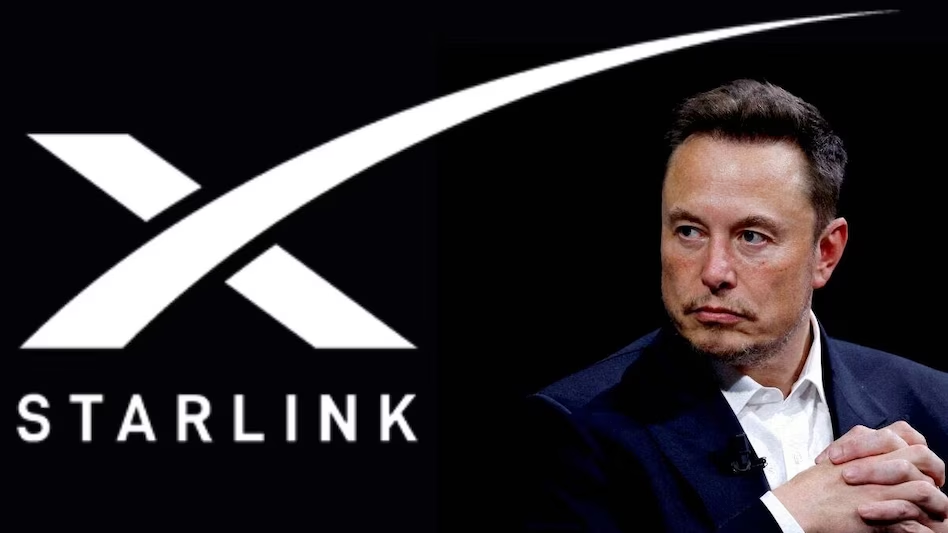
For holders of broad market funds such as Vanguard’s Total Stock Market ETF or BlackRock’s iShares Core S&P Total U.S. Stock Market ETF, SpaceX’s addition introduces a new line item into their portfolios. At current weightings, the position represents a fraction of a percentage point of total fund assets — sufficiently small that its near-term influence on overall fund performance is limited.
However, the significance of the inclusion extends beyond immediate portfolio impact. It establishes SpaceX as a component of the passive investing infrastructure that underpins a large share of retail and institutional capital in the United States. As the company’s market capitalisation evolves and as additional index providers complete their own inclusion processes, the weighting within affected funds may increase.
How Index Providers Accelerated SpaceX’s Inclusion
SpaceX’s path into index funds was accelerated by rule changes implemented by major index providers ahead of the IPO. Industry reports indicate that prominent index operators modified their eligibility criteria to allow fast-track inclusion of large, high-profile listings — a process that would ordinarily require a waiting period following a company’s market debut.
The rationale for expedited inclusion centres on the scale and market significance of the listing. SpaceX’s IPO was characterised as a record offering, and index providers determined that delaying inclusion would create a meaningful gap between index composition and the actual structure of the investable market. The Center for Research in Security Prices and S&P Dow Jones Indices acted first, with FTSE Russell and MSCI scheduled to follow.

Funds tracking the Nasdaq 100 are expected to carry a proportionally larger weighting in SpaceX than broader market funds, given the index’s concentration in technology and growth-oriented companies. SpaceX could be added to the Nasdaq 100 as early as July 2026, according to available reporting.
SpaceX Post-IPO Price Performance
SpaceX priced its IPO at $135 per share on June 12, 2026. The stock opened above $150 on its first day of trading and subsequently surged during its initial sessions before declining sharply. As of Tuesday, shares had fallen more than 25% from their post-IPO peak, reaching an intraday low of $147 before recovering to approximately $164.
The decline brought the stock below its first-day opening price, though it remained above the IPO pricing level of $135. The recovery on Tuesday occurred against a backdrop of broader weakness in the technology sector.
The price trajectory reflects a pattern observed in previous high-profile technology IPOs, in which initial demand and speculative activity drive share prices significantly above offering levels before a consolidation phase follows. Industry analysis has documented a historical tendency for large technology listings to outperform in the immediate post-IPO period before lagging broader market benchmarks over a multi-year horizon.

Risks and Limitations for Index Fund Holders
The automatic nature of index inclusion means that investors in affected funds have no mechanism to exclude SpaceX from their holdings without exiting the fund itself or switching to an alternative product. For investors who hold concerns about the company’s valuation, business model, or governance structure, this presents a limitation inherent to passive investing.
SpaceX’s current weighting in broad market funds is sufficiently small that adverse price movements are unlikely to materially affect overall fund returns. However, funds with more concentrated exposure — such as those tracking the Nasdaq 100 following its anticipated inclusion — carry greater sensitivity to SpaceX’s share price performance.
More broadly, the rapid inclusion of a newly listed, high-volatility stock into passive investment vehicles raises questions about the speed at which index rule changes are implemented. Critics of fast-track inclusion processes argue that expedited addition may expose index fund investors to elevated risk from stocks that have not yet established a stable post-IPO trading range or demonstrated sustained public market performance.
The historical record of large technology IPOs suggests that near-term price appreciation following inclusion events can be followed by extended periods of underperformance relative to benchmark indices, though outcomes vary across individual listings.

SpaceX as a Business: Context for Investors
SpaceX operates across three primary business segments: launch services, the Starlink satellite broadband network, and artificial intelligence development. The company has achieved significant scale across each of these areas. Starlink, in particular, has expanded to serve millions of subscribers globally and generates recurring subscription revenue — a business model characteristic that distinguishes it from pure-play launch companies.
The company’s AI operations represent a more nascent revenue stream, though they have attracted investor attention given the broader market premium applied to AI-exposed businesses in 2025 and 2026.
Prior to its IPO, SpaceX was among the most highly valued private companies in the world. Its transition to public markets subjects it to quarterly reporting requirements and the price discovery mechanisms of public equity markets — dynamics that introduce transparency as well as volatility relative to its prior private status.
Conclusion
SpaceX’s inclusion in major index funds marks a structural shift in the stock’s investor base, extending exposure to millions of retail investors who hold broad market funds in retirement and brokerage accounts. The practical effect on most fund holders at current weighting levels is limited, though it will grow if the company’s market capitalisation increases and as additional index providers complete their own inclusion processes.
The stock’s post-IPO volatility — a decline exceeding 25% from peak levels within days of listing — underscores the risk characteristics of newly public, high-profile equity offerings. Industry analysts note that index inclusion itself tends to provide a near-term price support mechanism as funds acquire shares to replicate index composition, but that this effect is distinct from the company’s underlying fundamental value trajectory, which will be assessed over subsequent reporting periods.

