



Financial pressure is increasingly affecting the essential spending decisions of lower-income households in the United Kingdom, with more than one-third reporting that they have skipped meals or reduced food consumption to manage costs. The finding comes from the autumn 2026 edition of the Financial Wellbeing Index published by Vanquis, which also records a deterioration in the financial wellbeing of households earning less than £40,000 a year.
The group’s index score fell to 64 out of 100 in the latest report, down from 68 in May 2026. By comparison, the score for the general population declined from 69 to 67 over the same period. Both remain in the index’s moderate financial wellbeing category, but the widening gap suggests that lower-income households are experiencing greater difficulty managing everyday expenses.
The findings point to pressure across several areas of household finances, including food, housing, healthcare, savings and debt repayment. They also highlight the limited financial reserves available to many households when unexpected costs arise.
What the Vanquis Financial Wellbeing Index Reveals
Vanquis’s autumn 2026 index examines the financial circumstances of UK households with annual incomes below £40,000. It combines anonymised transaction data from 58,263 lower-income households using the Snoop/SpendMapper platform with a consumer survey conducted by Mintel and Kantar.
The survey covered 2,000 adults between 23 September and 6 October 2026.
The latest index score shows a four-point decline among lower-income households since May, twice the two-point reduction recorded across the general population.
Financial wellbeing index scores
Scores out of 100, as reported by Vanquis.
May 2026
Autumn 2026
0255075100Lower-income householdsGeneral population

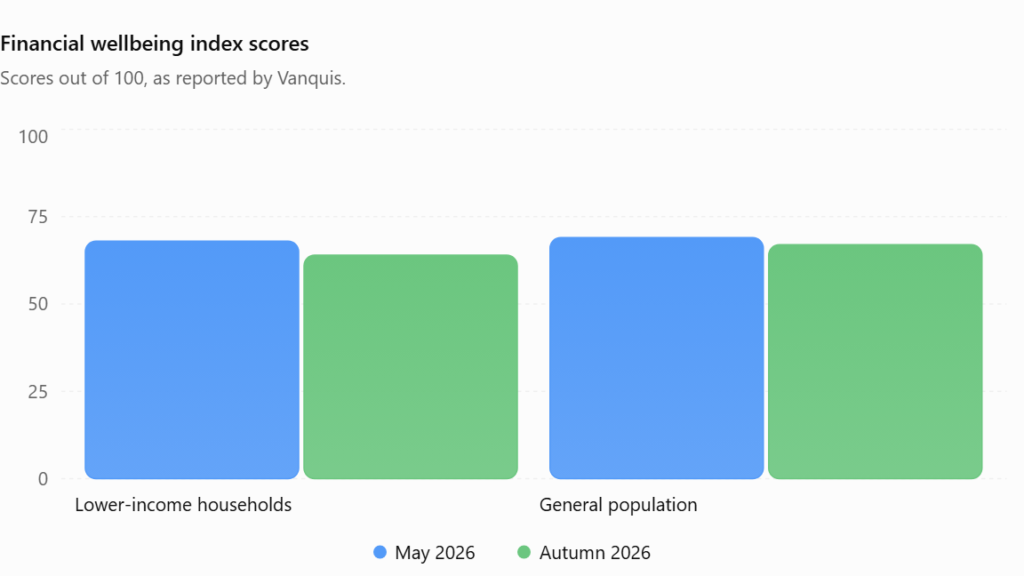
Although the two groups remain within the report’s moderate financial wellbeing band, the lower-income cohort is now close to the bottom of that category.
The index is a measure of financial wellbeing rather than a direct assessment of poverty. Its findings nevertheless provide insight into how households are managing their finances and whether they have enough flexibility to absorb rising costs.
Food and Healthcare Are Among the First Areas Affected
The most concerning findings relate to households reducing essential spending.
Vanquis reports that 36% of lower-income households had skipped meals or reduced the amount they ate during the previous three months because of financial pressure. This suggests that food affordability remains a significant concern, even as households adjust their shopping habits.
Healthcare is also being affected. A further 27% said they had delayed medical or dental treatment because they could not afford it.
These decisions can have consequences beyond immediate household budgets. Delaying treatment may allow health problems to worsen, potentially creating greater personal and financial costs later.
The survey also found that 49% of lower-income respondents said their financial situation had affected their mental wellbeing. This was the highest proportion recorded since the research began, compared with 42% in October 2024.
Taken together, the figures suggest that financial strain is affecting not only consumption but also access to essential services and household wellbeing.
Savings and Debt Repayment Are Becoming Harder
The index suggests that households have little room to recover financially after covering regular expenses.
Lower-income households retained an average of 4.6% of income after spending and payments in the latest quarter. This included savings and debt repayments. The figure was slightly higher than the previous quarter’s 4.5%, but the improvement masks a deterioration in other measures of financial resilience.
The amount being put into savings fell by 12.8% quarter on quarter. One in four lower-income households had no savings, compared with 7% of higher-income households.
Debt reduction also became less common. The proportion of lower-income households able to reduce their debt fell from 59% in May to 48% in the autumn report.
Financial resilience among lower-income households
Selected findings from Vanquis’s autumn 2026 index.
0%25%50%75%100%No savingsCould reduce debt in MayCould reduce debt in autumn
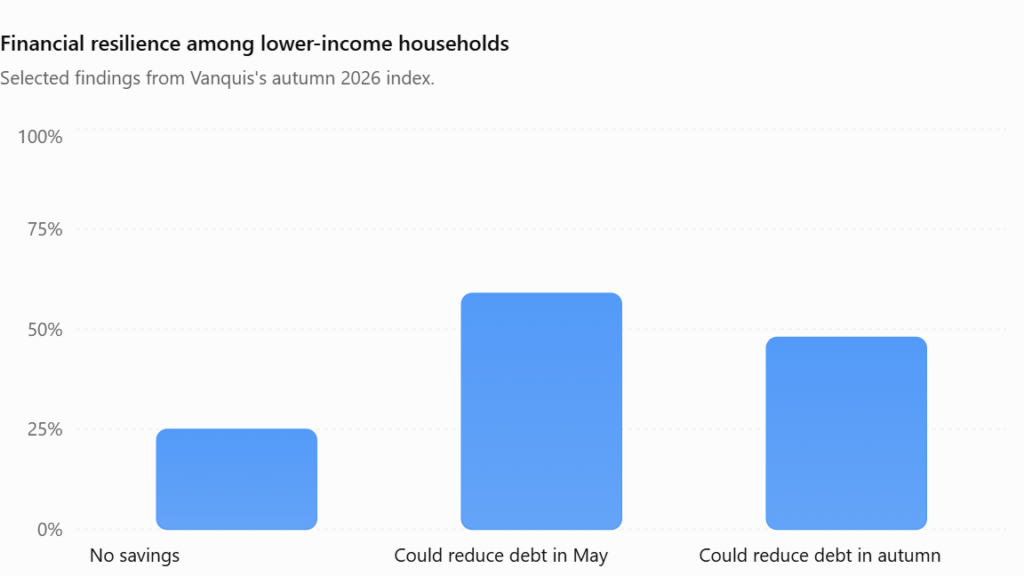
These figures point to pressure on both sides of household balance sheets. Fewer households are reducing outstanding debt, while the flow of money into savings is weakening.
For families without emergency reserves, an unexpected bill can quickly become a borrowing problem. That can create a cycle in which credit is used to cover essential spending, leaving less income available to repay existing balances.
Housing and Household Bills Continue to Rise
The report also highlights the cumulative effect of higher living costs.
Vanquis says overall household bills are more than 10% higher than two years ago. Over the same period, mortgage and rent costs rose by 24.1%, while water bills increased by 46.1%.
Grocery spending was 7.8% higher over two years. Households have responded by changing where and how they shop, but these adjustments have not fully offset the increase in costs.
The survey found that:
- 75% of lower-income respondents were cutting non-essential spending.
- 66% were buying more own-label groceries.
- 63% had switched to cheaper supermarkets.
- 44% said they could not absorb a £100 increase in regular monthly costs without cutting essentials, using savings or borrowing.
The figures illustrate the limits of household cost-cutting. Switching supermarket brands or reducing discretionary purchases can help manage a budget, but these changes cannot always compensate for increases in rent, mortgage payments, utilities and other recurring expenses.

The finding that 44% could not absorb an additional £100 in monthly costs is particularly significant. It suggests that a substantial share of the group has limited capacity to respond to further price increases or unexpected financial shocks.
Financial Stress Is Affecting Mental Wellbeing
Financial pressure is not confined to household budgets. Almost half of lower-income respondents, 49%, said their financial situation had affected their mental wellbeing.
That proportion has increased from 42% in October 2024, according to the index.
The relationship between financial insecurity and mental wellbeing can be difficult to separate. Worries about rent, bills, debt and food costs may create persistent stress, while poor mental wellbeing can make it harder to manage complex financial decisions or seek support.
The report also found that 14% of lower-income respondents described themselves as struggling or in trouble financially. Only 18% said their finances were healthy.
The figures suggest that a relatively small proportion of the lower-income group feels financially secure, even as many households continue to meet their regular payments.
Financial Support Remains Difficult to Access
Despite the reported pressures, relatively few respondents with financial concerns had sought professional assistance.
Only 6% had spoken to a financial adviser or debt counsellor, according to Vanquis. The report does not establish why people had not sought help, but the low figure points to a potential gap between financial need and access to support.
Barriers may include the perceived cost of advice, uncertainty about where to find free assistance, embarrassment about debt or a belief that the problem is not yet serious enough to require help.
The report also found that 47% of lower-income respondents expected the cost-of-living situation to worsen over the following three months.
That expectation could influence household decisions around borrowing, saving and discretionary spending. If people anticipate further cost increases, they may become more cautious about spending or rely more heavily on short-term credit to manage essential expenses.

FCA Consumer Duty Puts Financial Vulnerability Under Scrutiny
The findings arrive as UK regulators continue to focus on how financial services firms treat customers experiencing financial difficulty.
The Financial Conduct Authority’s Consumer Duty requires regulated firms to act in good faith, avoid foreseeable harm and support good outcomes for retail customers. The rules came into force for products and services open to sale or renewal on 31 July 2023, with closed products brought within scope from 31 July 2024. They are therefore an established regulatory requirement, rather than a newly introduced policy. FCA+2
The framework is relevant to lenders and other financial providers serving customers with limited financial resilience. Firms are expected to consider customer needs and circumstances, provide appropriate support and assess whether their products deliver fair value.
Vanquis’s findings offer an indication of the financial pressures affecting part of the population served by consumer credit providers. The data does not, on its own, establish whether individual lending products are affordable or whether a particular firm is meeting its regulatory obligations. Those assessments require evidence about product design, customer outcomes and lending practices.
The FCA’s guidance also highlights the importance of identifying customers in vulnerable circumstances and ensuring that firms have systems to respond appropriately. FCA+1
What the Findings Mean for Vanquis and the Consumer Credit Market
Vanquis, headquartered in Bradford and listed on the London Stock Exchange, serves approximately 1.79 million customers through its credit products and Snoop money-management platform, according to the supplied report.
The Financial Wellbeing Index gives the company a way to track household financial pressures and contribute to the wider discussion about financial inclusion. It also provides insight into the circumstances of consumers who may use credit to manage everyday spending.
For lenders, the findings present a complex market picture. Households facing rising essential costs may have greater demand for short-term financial support, but weak savings, existing debt and limited disposable income can also increase repayment risks.
This makes affordability assessment and responsible lending particularly important. Access to credit may help some households manage temporary cash-flow gaps, but borrowing cannot resolve a persistent shortfall between income and essential expenditure.
Vanquis deputy chief executive John Natalizia said the research reflected the difficulty many people face in meeting current financial commitments while remaining concerned about future costs. He said the company aimed to understand those pressures and provide practical support that reflects customers’ circumstances.
Conclusion
Vanquis’s autumn 2026 Financial Wellbeing Index points to a deterioration in the financial position of lower-income UK households. A score of 64 out of 100, falling savings contributions and a declining proportion of households reducing debt all indicate weakening financial resilience.
The finding that 36% have skipped meals or reduced food consumption because of financial pressure highlights the consequences beyond conventional measures of household spending. Delayed healthcare, mental wellbeing concerns and limited emergency savings suggest that many households have little room to absorb further increases in essential costs.
For lenders and policymakers, the challenge extends beyond access to financial products. The figures underline the importance of affordability, effective support for customers in difficulty and wider measures that help households build financial resilience.

