


Introduction
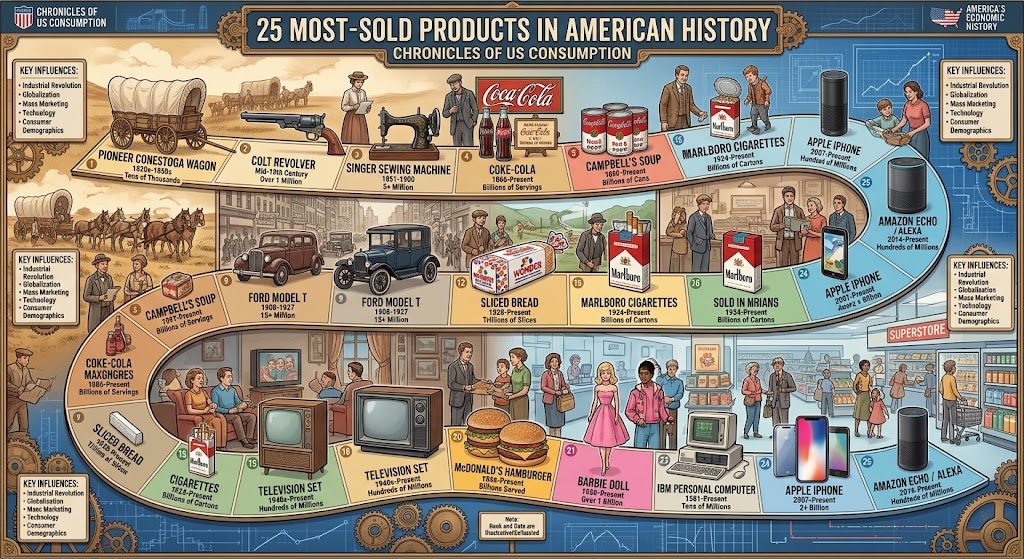
Some American consumer products have achieved sales volumes measured in billions, spanning decades of changes in technology, retail distribution and consumer behavior. From Coca-Cola and Levi’s jeans to the iPhone, Ford’s F-Series and Oreo cookies, these products have reached consumers on an exceptional scale.
However, a comparison of the 25 most-sold American products requires caution. The figures in the supplied dataset use different units, including servings, bags, vehicles, cards, bottles, pieces and boxes. Some are individual products, while others represent broad product categories or retail merchandise. There is also no single authoritative database that ranks all of these products on a consistent lifetime-sales basis.
For that reason, the list below is best understood as a compilation of reported or supplied lifetime sales estimates rather than a definitive statistical ranking. Company reporting confirms the enormous scale of several brands, but some of the specific lifetime figures in the source material cannot be independently verified from current company disclosures. For example, Coca-Cola currently reports 2.2 billion servings of its beverages per day, but that is not the same metric as a verified lifetime total of 400+ billion Coca-Cola servings. The Coca-Cola Company
What Makes a Product One of America’s Biggest Sellers?
Lifetime sales are generally influenced by several factors, including how long a product has been on the market, its distribution network, repeat-purchase frequency, population growth and whether consumers replace the product regularly.
A consumable such as a soft drink, tissue or battery can generate enormous unit volumes because consumers purchase it repeatedly. Durable products such as vehicles, smartphones and printers typically have lower lifetime unit counts because individual products are replaced less frequently.
The comparison also becomes complicated when brands report different measures. Coca-Cola, for example, reports servings and unit cases, while Ford reports vehicle sales and Apple has historically reported iPhone unit sales differently from its broader installed-device figures.
25 Products With the Largest Reported Sales Volumes
| Rank | Product / Brand | Reported Total Sold / Metric |
|---|---|---|
| 1 | Coca-Cola | 400+ billion servings |
| 2 | Lay’s | 30+ billion bags |
| 3 | iPhone | 2.4+ billion units |
| 4 | Ford F-Series | 40+ million units |
| 5 | Levi’s Jeans | 20+ billion pairs |
| 6 | Amazon products | 100+ billion items sold |
| 7 | Hershey’s Chocolate | 100+ billion bars |
| 8 | Nike sneakers | 2+ billion pairs |
| 9 | Budweiser Beer | 300+ billion bottles/cans |
| 10 | McDonald’s Big Mac | 10+ billion sold |
| 11 | Walmart products | 100+ billion items sold |
| 12 | VISA credit cards | 50+ billion cards |
| 13 | Johnson’s Baby | 50+ billion units |
| 14 | Tide detergent | 30+ billion bottles |
| 15 | Gillette razors | 20+ billion units |
| 16 | HP printers | 100+ million units |
| 17 | Colgate toothpaste | 20+ billion tubes |
| 18 | Heinz ketchup | 20+ billion bottles |
| 19 | Kleenex tissues | 100+ billion boxes |
| 20 | Campbell’s Soup | 50+ billion cans |
| 21 | Duracell batteries | 50+ billion units |
| 22 | Starbucks drinks | 10+ billion cups |
| 23 | M&M’s | 100+ billion pieces |
| 24 | Gatorade | 30+ billion bottles |
| 25 | Oreo cookies | 50+ billion cookies |
The figures above reproduce the supplied dataset’s reported metrics. They should not be interpreted as a standardized, independently audited ranking because the products use different measurement units and several lifetime estimates lack a directly comparable public company disclosure.
Coca-Cola’s Scale Is Difficult to Compare With Durable Goods
Coca-Cola sits at the top of the supplied list with a reported 400+ billion servings.
The scale of Coca-Cola’s distribution is well documented. The Coca-Cola Company says its beverages bearing company-owned or licensed trademarks are consumed at a rate of approximately 2.2 billion servings per day worldwide. The company operates through bottling partners, distributors, wholesalers and retailers in more than 200 countries and territories. The Coca-Cola Company
Coca-Cola also reported that its system sold 33.7 billion unit cases of its products in 2024. Trademark Coca-Cola accounted for 47% of worldwide unit-case volume that year. The Coca-Cola Company

These official metrics illustrate why beverage products can accumulate enormous lifetime volumes. They also show why a “servings” figure should not be directly compared with the number of cars or smartphones sold.
The iPhone Is an Exception Among Consumer Electronics
The iPhone is listed in the supplied data at 2.4+ billion units, placing it among the highest-volume durable consumer products in the compilation.
Unlike frequently purchased consumer goods, smartphones are replacement products. Consumers generally purchase a new device periodically rather than buying the same product every day or week.
Apple’s more recent reporting illustrates another measurement issue. In January 2026, Apple said its installed base had surpassed 2.5 billion active devices, but that figure covers all active Apple devices rather than cumulative iPhone sales. Apple
Consequently, active installed devices should not be used as a substitute for cumulative iPhone units sold.
Ford F-Series Shows the Scale of Long-Running Vehicle Brands
The Ford F-Series appears fourth in the supplied ranking, with 40+ million units reported.
Vehicles have much lower unit turnover than food, beverages or household consumables, making tens of millions of lifetime sales significant. The F-Series has also been sold over many decades, allowing successive generations of the truck line to contribute to cumulative volume.
This is a different business model from products such as toothpaste, tissues and soft drinks, where the same consumer can purchase the product repeatedly throughout a year.
Levi’s Demonstrates the Longevity of a Consumer Brand
Levi’s jeans are listed at 20+ billion pairs in the supplied data. That particular lifetime figure should be treated cautiously because Levi Strauss & Co. does not appear to publish a standardized historical cumulative unit-sales figure supporting that exact number.
The company’s own history confirms the longevity and global reach of the brand. Levi Strauss and Jacob Davis received the patent for their riveted work pants in 1873, while the 501 product line was created in 1890. The company now sells products in 120 countries and describes itself as a global leader in jeanswear. Levi Strauss

The company’s disclosures provide evidence of the 501’s continuing commercial scale, but not a directly comparable lifetime total of 20+ billion pairs. Levi Strauss
Consumable Products Dominate the Largest Unit Counts
A notable feature of the list is the number of products purchased repeatedly.
Examples include:
- Lay’s: 30+ billion bags
- Hershey’s Chocolate: 100+ billion bars
- Budweiser: 300+ billion bottles/cans
- Tide: 30+ billion bottles
- Colgate: 20+ billion tubes
- Heinz ketchup: 20+ billion bottles
- Campbell’s Soup: 50+ billion cans
- Duracell: 50+ billion batteries
- M&M’s: 100+ billion pieces
- Oreo: 50+ billion cookies
These figures illustrate how repeat purchasing can generate enormous cumulative sales even when individual transactions involve relatively inexpensive products.
By contrast, durable products such as vehicles and printers generally require much longer replacement cycles.
Retail Platforms Require a Different Definition of “Product”
The supplied ranking includes Amazon products at 100+ billion items sold and Walmart products at 100+ billion items sold.
These entries should not be treated as individual products comparable with an iPhone, Big Mac or Ford F-Series. Amazon and Walmart are retail platforms and companies selling large numbers of different products across many categories.
This is a major methodological weakness in the original ranking.
A more precise comparison would separate:
- Individual products
- Product lines
- Brands
- Retail platforms
- Payment networks
Without that separation, the ranking can create misleading comparisons between fundamentally different business models.

Payment Cards Are Also Difficult to Compare
The list places VISA credit cards at 50+ billion cards.
Payment networks require a different metric from physical consumer products. A payment card can be issued, replaced, renewed or reissued, and a single consumer can possess multiple cards over time.
In addition, Visa is primarily a payments network rather than a consumer-goods manufacturer. Counting cards therefore measures issuance or circulation rather than the cumulative sale of a physical product in the conventional sense.
The same principle applies to broad categories such as “Johnson’s Baby” or “Nike sneakers,” where the number may encompass multiple products and generations.
Risks and Limitations of Lifetime Sales Rankings
The largest limitation is measurement consistency.
A list combining servings, bags, units, pairs, bottles, cards, boxes and pieces cannot produce a statistically meaningful universal ranking. One billion servings of a beverage are not economically or operationally equivalent to one billion automobiles, shoes or smartphones.
There is also a distinction between sales, shipments, servings and items sold through a retail platform. Company reporting can use any of these measures depending on the business model.
Another limitation is historical verification. Some brands have existed for more than a century and do not maintain publicly accessible records covering every unit sold throughout their entire commercial history.
For those reasons, the figures should be treated as reported estimates rather than a single audited database of America’s highest-selling products.
Why These Products Became Commercially Significant
Despite the methodological limitations, the list highlights several recurring characteristics of successful consumer products.

Long Market Lifespans
Products such as Coca-Cola, Levi’s and Ford’s F-Series have been sold across multiple generations of consumers.
Extensive Distribution
Large distribution networks allow products to reach consumers across geographic markets. Coca-Cola, for example, operates through a global bottling and distribution system serving more than 200 countries and territories. The Coca-Cola Company
Repeat Purchases
Consumables can accumulate enormous lifetime sales because individual consumers purchase them repeatedly.
Brand Recognition
Products with established brands can maintain demand over long periods while adapting packaging, pricing and product formulations.
Product Evolution
The products themselves often change over time. A modern version of a long-running product may differ substantially from its original form while retaining the same brand or product-line identity.
Future Outlook for Mass-Market Consumer Products
Future sales volumes will increasingly depend on population growth, consumer preferences, pricing, distribution, technology and changes in retail behavior.
Digital commerce has also changed how consumer products reach households. Meanwhile, smartphones and other electronics have become increasingly integrated into everyday life, while traditional packaged goods continue to benefit from high purchase frequency.
The distinction between a brand, product line and individual product will become increasingly important as companies expand portfolios and sell through third-party marketplaces.
Conclusion
The supplied list contains several of the world’s most recognizable American consumer brands and products, from Coca-Cola and Lay’s to the iPhone, Ford F-Series, Levi’s, Nike, Oreo and Gatorade.
Its central lesson is that enormous sales volumes come from different commercial models. Consumable goods can reach billions of units through frequent purchases, while durable products accumulate sales over decades. Retail platforms and payment networks operate on yet another scale and should not be directly compared with individual products.
The ranking is therefore useful as a snapshot of reported commercial scale, but not as a definitive, apples-to-apples ranking of the 25 best-selling American products. Several of the supplied lifetime figures also require independent verification before they can be presented as audited historical totals. Official company disclosures support the exceptional scale of brands such as Coca-Cola and Levi’s, while using different metrics than some of the figures in the supplied dataset.

