


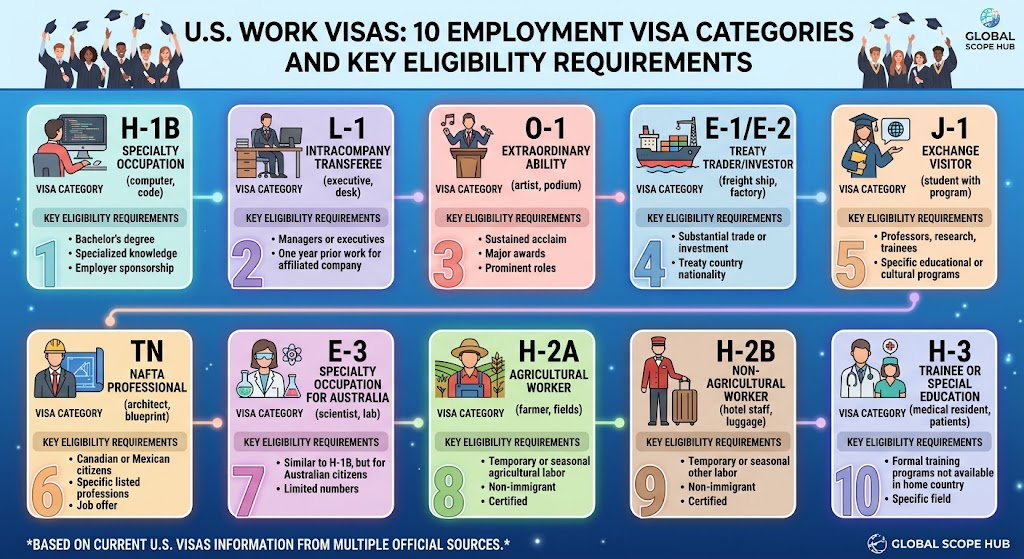
Working in the United States as a foreign national generally requires immigration authorization tied to the type of employment, the applicant’s qualifications and, in many cases, the U.S. employer or organization involved.
The U.S. immigration system contains several employment-based visa categories. Some allow temporary employment, while others are designed for foreign nationals seeking permanent residence through employment. The appropriate category depends on factors including the occupation, nationality, employer relationship, qualifications, investment activity and intended duration of stay.
Understanding the distinction between temporary and employment-based immigrant visas is an important first step for people considering a move to the United States for work. The U.S. Department of State currently groups employment-related visa routes into categories including temporary workers, treaty traders and investors, Australian specialty-occupation workers and Canadian and Mexican professionals under the USMCA framework.
What Is a U.S. Work Visa?
A U.S. work visa is an immigration classification that allows an eligible foreign national to enter or remain in the United States for authorized employment under specified conditions.
The term “work visa” covers multiple categories rather than one single permit. Some are connected to a particular employer, occupation or business relationship. Others are based on an applicant’s professional achievements or a permanent employment opportunity.
A visa should also be distinguished from an Employment Authorization Document (EAD). An EAD, issued through Form I-765 when an individual qualifies, is evidence of employment authorization for eligible categories. Not every foreign worker follows the same EAD process because employment authorization can depend on the person’s underlying immigration status.
For temporary employment categories, the process can involve an employer or other qualifying petitioner obtaining approval before the worker applies for a visa through a U.S. embassy or consulate. The exact procedure depends on the visa category.
Temporary U.S. Work Visas
Temporary employment visas are generally intended for foreign nationals whose authorized U.S. employment is limited to a defined immigration classification and period.
The Department of State identifies several temporary employment categories, including H, L, O, P and Q classifications, as well as separate treaty, USMCA and Australian specialty-occupation categories.
1. H-1B Visa for Specialty Occupations
The H-1B category is designed for specialty occupations requiring highly specialized knowledge and normally involving qualifying educational or professional requirements.
Common fields associated with H-1B employment include technology, engineering, mathematics, science, medicine and other professional occupations. USCIS data shows the substantial role of computer-related occupations within H-1B employment: in fiscal year 2024, computer-related occupations accounted for about 63.9% of all H-1B beneficiaries in the agency’s reported data.
H-1B cases are generally employer-linked and subject to specific statutory and regulatory requirements. Certain H-1B cases are also affected by annual numerical limits.
Because the category has detailed eligibility and filing requirements, a job title alone does not determine whether a position qualifies as a specialty occupation.
2. L-1 Intracompany Transferee Visa
The L-1 category is designed for qualifying employees transferred from an overseas company to a related U.S. entity.
It is particularly relevant to multinational businesses that operate across borders.
There are two principal classifications:
- L-1A: Generally covers qualifying managers and executives.
- L-1B: Generally covers employees with specialized knowledge.
The category can also apply when an eligible foreign company sends a qualifying employee to establish a new U.S. office, subject to the applicable requirements.
A central consideration is the employee’s qualifying relationship with the overseas and U.S. businesses and the person’s prior employment with the organization.
3. O-1 Visa for Individuals With Extraordinary Ability
The O-1 category is intended for individuals who can demonstrate extraordinary ability or achievement in specified fields.

Eligible fields can include:
- Sciences
- Education
- Business
- Arts
- Athletics
- Motion pictures and television
The standard is substantially higher than simply having professional experience. Applicants generally need documentary evidence demonstrating sustained recognition and achievement in their field.
The category can therefore be relevant to researchers, entrepreneurs, artists, athletes, executives and other professionals whose careers include significant documented accomplishments.
4. E-1 Treaty Trader and E-2 Treaty Investor Visas
The E-1 and E-2 categories are based on treaty relationships between the United States and qualifying countries.
The E-1 classification is associated with substantial trade between the United States and a qualifying treaty country. The E-2 classification is associated with qualifying investment in a U.S. enterprise.
Nationality is an important eligibility factor because these categories are generally available only to nationals of countries that have the required treaty relationship or equivalent arrangement with the United States.
These categories therefore operate differently from employer-sponsored employment visas such as H-1B.
5. TN Visa Under the USMCA
The TN category allows qualifying professionals from Canada and Mexico to work in the United States in professions covered by the applicable USMCA provisions.
The original source refers to the North American Free Trade Agreement, or NAFTA. The current framework is the United States-Mexico-Canada Agreement (USMCA).
Eligibility depends on factors including nationality, the profession, the proposed U.S. employment and the applicant’s professional qualifications. The U.S. Department of State continues to identify TN/TD as the professional-worker category for Canadian and Mexican nationals.
6. E-3 Visa for Australian Specialty-Occupation Workers
The E-3 category is specifically available to qualifying Australian nationals working in specialty occupations in the United States.
The applicant generally needs:
- Australian nationality
- A qualifying specialty occupation
- The required academic or professional credentials
- A legitimate U.S. employment opportunity
- Compliance with the applicable E-3 requirements
The category has an annual numerical limit for principal applicants, while qualifying spouses and children are treated separately under the immigration rules.
7. H-2A Temporary Agricultural Worker Visa
The H-2A program permits qualifying U.S. agricultural employers to bring foreign workers to the United States for temporary or seasonal agricultural employment when the statutory requirements are met.
The process involves requirements concerning the temporary nature of the work and U.S. labor protections, including Department of Labor procedures before the immigration petition stage.
The H-2A program should not be confused with H-2B, which concerns certain temporary non-agricultural employment. The Department of State lists H-2A as the temporary agricultural-worker category.
Eligibility also depends on nationality and the countries designated under the applicable program rules. The list and program conditions can change, so applicants should rely on current government information rather than older country lists.
Employment-Based Immigrant Visas
Temporary employment visas are different from employment-based immigrant categories.
Employment-based immigrant classifications can lead to lawful permanent residence, commonly represented by a green card. The principal employment-based preference categories include EB-1, EB-2 and EB-3, alongside other employment-based classifications.

USCIS describes EB-1 as covering extraordinary ability, outstanding professors and researchers, and certain multinational executives and managers. EB-2 covers qualifying professionals with advanced degrees or exceptional ability, while EB-3 covers skilled workers, professionals and certain other workers.
8. EB-1 First Preference
The EB-1 category contains three major pathways.
EB-1A: Extraordinary Ability
This pathway is intended for people who can demonstrate extraordinary ability in areas such as:
- Sciences
- Arts
- Education
- Business
- Athletics
The evidence must establish the level of achievement required by the immigration regulations.
EB-1B: Outstanding Professors and Researchers
This route applies to qualifying professors and researchers who meet the applicable requirements for international recognition and other statutory criteria.
The applicant must also satisfy the employment-related requirements associated with this classification.
EB-1C: Multinational Managers and Executives
This classification applies to certain managers and executives of multinational companies who meet the required qualifying relationship and employment conditions.
The EB-1 category therefore covers several distinct professional profiles rather than one uniform employment pathway.
9. EB-2 Second Preference
The EB-2 category generally covers two broad groups:
- Professionals holding advanced degrees or their equivalent
- Individuals with exceptional ability in the sciences, arts or business
Evidence requirements depend on the specific basis of the application.
For an advanced-degree case, documentation can include academic records demonstrating the required qualification. Exceptional-ability cases involve additional evidentiary requirements.
Some EB-2 applicants may also pursue a National Interest Waiver (NIW) when they meet the separate legal requirements for that pathway. An NIW is not automatically available simply because an applicant has an advanced degree or professional experience.
10. EB-3 Third Preference
The EB-3 category covers three principal groups:
Skilled Workers
This pathway generally concerns positions requiring at least two years of training or work experience, subject to the applicable requirements.
Professionals
This category generally covers positions requiring a bachelor’s degree or equivalent qualification.
Other Workers
The third EB-3 classification covers certain jobs requiring less than two years of training or experience, subject to the applicable immigration and labor-certification requirements.
Employment-based EB-3 cases can involve a permanent full-time job offer and, where required, labor certification.
How the U.S. Work Visa Process Generally Works
The process depends heavily on the visa category, but employment-based applications commonly involve several stages.
Step 1: Identify the Immigration Category
The first question is not simply whether a person has a job offer. The proposed employment must fit a specific immigration classification.

Factors can include:
- Occupation
- Education
- Professional experience
- Nationality
- Employer relationship
- Salary and employment conditions
- Investment activity
- Temporary or permanent employment
- Previous employment with a multinational company
Step 2: Determine Whether Employer Sponsorship Is Required
Many employment categories involve a U.S. employer or qualifying organization.
For petition-based temporary employment categories, the petitioner generally must complete the required process with U.S. immigration authorities before the worker proceeds with visa processing abroad.
The precise sequence varies between visa categories.
Step 3: Petition or Supporting Documentation
Depending on the classification, the case may involve a petition, labor certification, employment documentation, evidence of qualifications or other supporting materials.
For immigrant employment categories, the process can also involve an immigrant petition and subsequent permanent-residence processing.
Step 4: Visa Application and Consular Processing
Foreign nationals applying outside the United States generally proceed through a U.S. embassy or consulate after completing the applicable petition or eligibility process.
The Department of State notes that the steps before visa application vary according to the employment category.
Step 5: Maintain the Conditions of the Immigration Status
Approval of a work-related immigration category does not mean that every type of employment is automatically permitted.
Workers must comply with the conditions attached to their specific status, including restrictions concerning employer, occupation, duration or other requirements.
Work Visa vs. Employment Authorization Document
A common source of confusion is the difference between a visa classification and an Employment Authorization Document.
An EAD is evidence of employment authorization issued to eligible applicants. USCIS explains that Form I-765 is used by people who fall into qualifying employment-authorization categories.
Not every foreign national who works in the United States needs an EAD in the same way. Some immigration classifications provide employment authorization based on the underlying status or specific regulatory provisions.
As a result, having an EAD and having a particular employment visa are not interchangeable concepts.
Can a Temporary Work Visa Lead to Permanent Residence?
A temporary employment classification does not automatically become a green card.
Some foreign workers may later qualify for an employment-based immigrant category, but the requirements are separate. Depending on the circumstances, a worker may need an employer-sponsored immigrant petition, labor certification or another qualifying basis.
For example, EB-1, EB-2 and EB-3 each have different eligibility requirements. USCIS identifies these as separate employment-based immigrant preference categories rather than automatic extensions of temporary visas.
The timing and availability of permanent-residence processing can also depend on visa-number availability and the applicant’s circumstances.
Key Factors That Determine the Appropriate Visa
For someone planning to work in the United States, several factors can determine which immigration category is relevant.

Occupation
Some categories are specifically tied to specialty occupations or designated professions.
Education and Experience
Academic qualifications, professional experience and evidence of achievement can be central to eligibility.
Employer Relationship
An applicant working for a multinational company may have access to a different immigration route from someone being recruited directly by a U.S. employer.
Nationality
Certain categories are restricted to nationals of particular countries. E-1, E-2, E-3 and TN are examples of categories where nationality can be particularly important.
Temporary or Permanent Plans
A worker planning a temporary assignment may face a different immigration process from someone seeking permanent residence through employment.
Evidence
Employment immigration cases often depend on documentary evidence. Qualifications, employment history, job duties, corporate relationships and professional achievements may all become relevant depending on the category.
Important Limitations and Risks
U.S. employment immigration rules are highly category-specific. A person who qualifies for one type of work authorization may not qualify for another.
Visa availability, annual limits, petition requirements, labor certification rules and government procedures can also change over time.
Applicants should therefore avoid relying on old visa guides, employer advertisements or general statements that suggest that a particular job automatically qualifies for a particular visa.
For example, having a bachelor’s degree does not by itself guarantee H-1B eligibility, while having extensive professional experience does not automatically qualify someone for EB-1 or EB-2.
The Department of State maintains current information on U.S. employment visa categories, while USCIS provides detailed eligibility and filing information for immigration benefits.
What Foreign Workers Should Check Before Applying
Before beginning an employment-based immigration process, applicants generally need to establish:
- The exact job and employer involved
- The immigration category that corresponds to the proposed employment
- Whether the employer must sponsor or petition
- Whether the applicant meets the education or experience requirements
- Whether nationality affects eligibility
- Whether the category has an annual numerical limit
- Whether labor certification is required
- Whether the application is temporary or intended to support permanent residence
- What documentation is required
- Whether current government rules have changed since earlier guidance was published
These factors can materially affect the immigration process and should be evaluated using current official requirements.
Frequently Asked Questions
How do I apply for a U.S. work visa?
The process depends on the visa category. For many petition-based employment classifications, a qualifying U.S. employer or other petitioner must first complete the required petition process. A foreign worker outside the United States may then apply for the relevant visa through a U.S. embassy or consulate. The exact sequence varies by category.
Which U.S. work visas are temporary?
Temporary employment categories include H-1B, L-1, O-1, E-1, E-2, TN, E-3 and H-2A, among others. The U.S. Department of State also lists other employment categories, including H-2B, P and Q classifications.
Which employment visas can lead to permanent residence?
Employment-based immigrant classifications such as EB-1, EB-2 and EB-3 are designed for permanent immigration. A temporary worker may potentially pursue a separate employment-based immigrant route if they meet its requirements, but a temporary visa does not automatically convert into permanent residence.
Who can receive an Employment Authorization Document?
Eligibility for an EAD depends on the individual’s immigration category or circumstances. USCIS uses Form I-765 for eligible applicants, and employment authorization may in some circumstances be incident to immigration status rather than requiring a separate EAD.
Does having a U.S. job offer guarantee a work visa?
No. A job offer is only one element of eligibility for many employment categories. The position, employer, applicant’s qualifications, nationality and specific immigration classification all matter.
Conclusion
The U.S. employment immigration system contains multiple routes for foreign workers, ranging from temporary employment categories to employment-based immigrant classifications.
H-1B can apply to qualifying specialty occupations, L-1 to certain multinational-company transfers, O-1 to individuals who meet the extraordinary-ability standard, E-1 and E-2 to qualifying treaty traders and investors, TN to eligible Canadian and Mexican professionals, and E-3 to qualifying Australian specialty-occupation workers. H-2A addresses qualifying temporary agricultural employment. Meanwhile, EB-1, EB-2 and EB-3 provide separate employment-based pathways toward permanent residence.
The central issue is therefore not simply obtaining a “U.S. work visa.” It is identifying the immigration category that corresponds to the person’s employment, qualifications, nationality and intended stay, and then meeting the requirements of that specific category.
Because U.S. immigration rules and administrative procedures can change, current information from the U.S. Department of State and USCIS should be checked before an application is prepared. This article provides general information and is not legal advice.

