


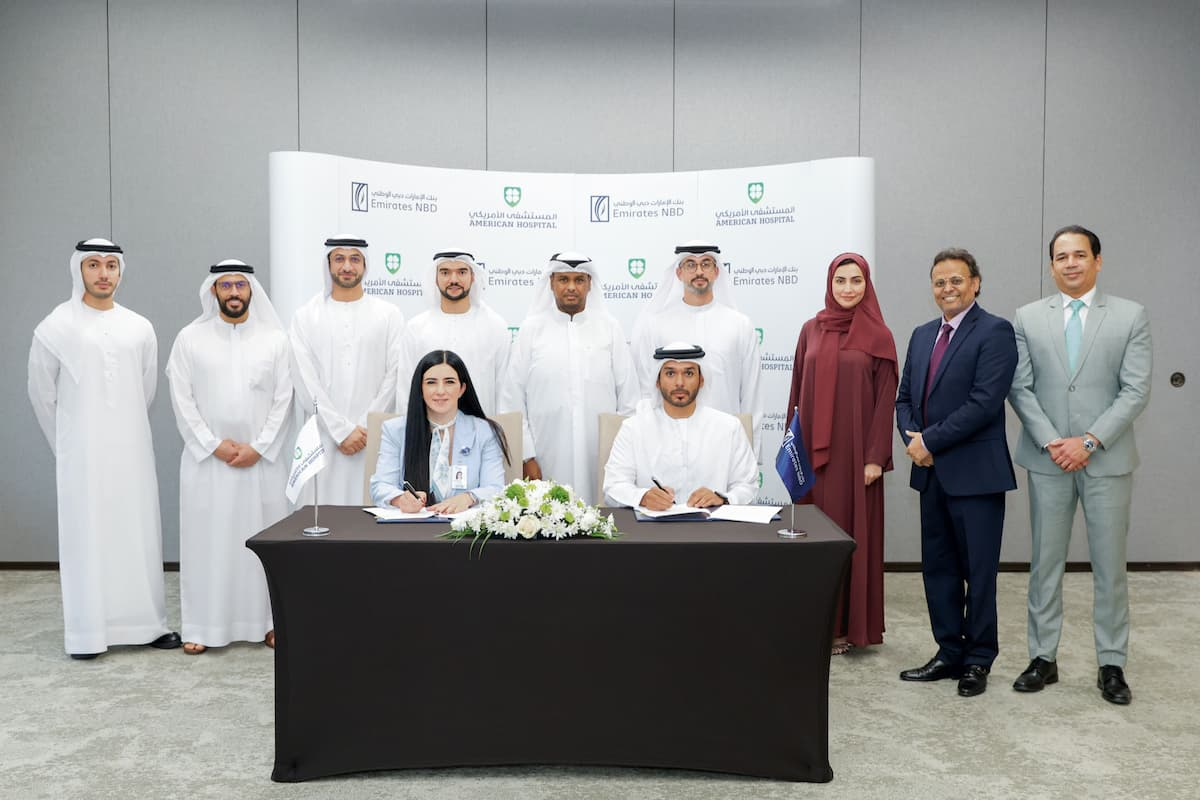
Emirates NBD has signed a Memorandum of Understanding (MoU) with American Hospital Dubai and the Mohamed & Obaid Almulla Group to establish an employee banking and financial wellness framework for staff across the partner organizations.
The agreement is designed to combine financial education, banking support and employee onboarding services. It reflects a broader trend in the UAE banking market in which financial institutions use corporate relationships to expand their retail customer base while offering employees access to workplace-focused banking services.
The financial terms of the agreement were not disclosed. The announcement also did not specify the number of employees covered, the individual banking products that will be made available or whether the MoU will lead to a longer-term commercial contract.
What the Emirates NBD Employee Banking Agreement Covers
The partnership brings together Emirates NBD, American Hospital Dubai and the Mohamed & Obaid Almulla Group under a framework focused on employee financial services.
According to the announcement, the collaboration will include:
- Financial awareness and financial wellness sessions
- Support for opening bank accounts
- Tailored banking solutions for employees
- Structured onboarding assistance
The initiative is being developed through Emirates NBD’s Employee Banking division, which works with corporate organizations to provide banking services to their employees.
Unlike a conventional corporate banking agreement focused on payments, lending or treasury services, employee banking partnerships extend the relationship into the retail banking needs of workers.
How Employee Banking Works in the UAE
Employee banking programs generally connect a bank with an employer and its workforce.
Employer relationship
The bank establishes a relationship with the employer, creating an organized channel through which eligible employees can access banking services.
This can simplify customer acquisition because the financial institution does not need to reach every prospective customer independently.

Employee onboarding
Banks can provide dedicated account-opening support and onboarding processes at the workplace or through digital channels.
For employees, this can make the transition into a banking relationship more structured, particularly where salary payments are involved.
Retail product distribution
Once employees become customers, banks may have opportunities to provide additional services such as personal banking, financing, insurance and digital banking products, subject to eligibility and applicable regulations.
The commercial value of these arrangements therefore depends partly on how many employees become active customers and the extent to which they maintain their banking relationship.
Why Employee Banking Matters to UAE Banks
Employee banking has become an important customer-acquisition channel across the Gulf because employers can provide banks with access to sizeable groups of salaried workers.
For banks, the model can potentially reduce some of the costs associated with acquiring customers individually. It also creates opportunities to build relationships around salary accounts and other financial services.
For employers, employee banking arrangements can form part of broader workplace benefits, particularly when financial education and account-opening assistance are included.
The model also supports the wider digitization of retail banking. Banks can combine employer-led acquisition with mobile applications and digital onboarding rather than relying exclusively on branch-based customer acquisition.
Emirates NBD’s Position in Digital and Employee Banking
Emirates NBD is one of the largest banking groups in the UAE and has continued to develop both corporate and consumer banking channels.
The bank reported 25 million active customers and AED 1.3 trillion in total assets as at June 2026, according to the information accompanying the partnership announcement.
Its digital banking strategy also includes Liv, which had close to half a million users at the time of the announcement.
Employee banking provides a different acquisition route from direct-to-consumer digital channels. Instead of relying primarily on customers discovering a banking application independently, the employer relationship creates an established distribution point through which banking services can be introduced to employees.
The two approaches can therefore operate alongside each other, with corporate partnerships supporting customer acquisition and digital platforms handling ongoing banking activity.
UAE Consumer Protection Rules and Employee Banking
Employer-linked banking arrangements operate within the UAE’s broader consumer protection framework.
The Central Bank of the UAE has established consumer protection requirements covering areas such as transparency, product information and the treatment of banking customers.
This is relevant when banks offer preferential products or services through employer relationships. Any banking products introduced under the partnership remain subject to the applicable regulatory requirements governing their pricing, terms and customer disclosures.
An MoU itself does not constitute the launch of a new regulated financial product. Specific banking products introduced through the arrangement would need to comply with the relevant regulatory framework.
Competitive Landscape for Corporate-to-Retail Banking
Emirates NBD is not alone in using employer relationships to develop retail banking opportunities in the UAE.
Other major banks, including First Abu Dhabi Bank, Mashreq and HSBC’s UAE operations, have corporate and employee banking offerings that connect workplace relationships with individual financial services.
Competition in this segment extends beyond interest rates or account fees. Banks can differentiate their employee banking propositions through onboarding processes, digital services, financial education, customer support and the range of products available to eligible employees.

The size of an employer relationship can also influence the commercial attractiveness of such partnerships, although employee numbers and expected customer conversion rates were not disclosed in this agreement.
Financial Impact and Business Implications
No financial terms were disclosed for the Emirates NBD, American Hospital Dubai and Mohamed & Obaid Almulla Group agreement.
As a result, the immediate financial impact cannot be measured from the announcement alone.
Several indicators would provide greater visibility into the commercial significance of the partnership:
- Number of employees eligible for the program
- Number of employees who open accounts
- Conversion into active banking customers
- Salary-account volumes
- Adoption of additional banking products
- Participation in financial wellness programs
- Duration of the partnership
These metrics are particularly relevant because signing an employer does not necessarily translate into equivalent growth in active retail customers.
An employee may already have an existing banking relationship, may choose not to switch banks or may use only selected services offered through an employer program.
Risks and Limitations of Employer-Linked Banking
Employee banking partnerships can provide banks with an efficient customer-acquisition channel, but they also have limitations.
Customer choice
Employees remain individual banking customers, and participation or product selection may depend on the terms and applicable customer protections.
Product suitability
A banking product offered through an employer arrangement still needs to be appropriate for the customer and clearly explained. Corporate sponsorship does not eliminate individual eligibility requirements.
Conversion uncertainty
The number of employees associated with an employer does not necessarily correspond to the number of new customers acquired by the bank.

Partnership duration
An MoU establishes a framework for cooperation but does not necessarily indicate a completed long-term commercial arrangement. Future disclosures would be required to establish whether the agreement develops into a broader contractual relationship.
What Comes Next for the Partnership
The next measurable stage will be the implementation of the financial awareness sessions and employee onboarding activities described in the agreement.
Further disclosures could also clarify the banking products available to eligible employees and the scale of the program.
Until those details are released, the agreement is best viewed as a framework for cooperation rather than a new financial product launch or a disclosed source of material financial revenue for Emirates NBD.
Future Outlook for Employee Banking in the Gulf
Employer-linked banking is likely to remain relevant to Gulf financial institutions as banks compete for salaried customers while expanding digital distribution.
The model combines an established corporate relationship with retail banking acquisition and can connect financial education with access to banking services.
Its effectiveness will ultimately depend on customer participation, product adoption, service quality and regulatory compliance. For banks, the focus is likely to remain on converting employer relationships into sustainable customer relationships rather than simply increasing the number of corporate partnerships.
Conclusion
Emirates NBD’s MoU with American Hospital Dubai and the Mohamed & Obaid Almulla Group establishes a framework for employee financial wellness, banking education and structured account onboarding.
The agreement illustrates how UAE banks are increasingly using employer relationships as a bridge between corporate and retail banking. However, the absence of disclosed financial terms, employee numbers and customer-conversion targets means its immediate commercial impact cannot yet be quantified.
Further information on product offerings, employee participation and implementation will provide a clearer indication of the partnership’s scale and long-term significance.

