


Introduction
Graduating from college without professional work experience does not necessarily prevent a person from entering the workforce. Many entry-level positions are designed around transferable skills, academic knowledge and the ability to learn on the job rather than years of previous employment.
For recent graduates, the challenge is often identifying positions where limited professional experience is not the primary hiring requirement. Administrative support, customer service, marketing, laboratory work, finance, writing, sales and other fields can provide starting points for a professional career.
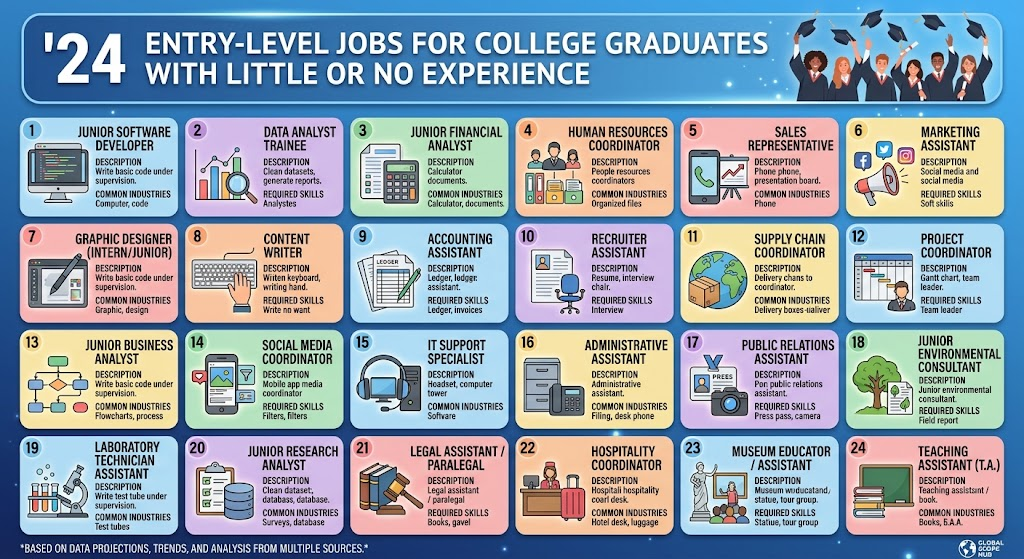
The source material behind this article identifies 24 entry-level occupations that college graduates can consider with little or no professional experience. The supplied salary figures are national average salary figures from Indeed and should be treated as reference points rather than guaranteed starting salaries.
How College Graduates Can Find Work Without Experience
A lack of formal employment history does not mean a graduate has no relevant experience.
University projects, internships, volunteer activities, student organisations, fundraising campaigns, research assignments and freelance work can demonstrate skills that employers use in professional settings.
Focus on transferable skills
Communication, organisation, time management, research, teamwork and attention to detail can be relevant across many entry-level occupations.
A graduate who has not previously held a full-time position can explain where these abilities were developed and how they relate to the role being targeted.
Connect previous activities to the job
Experience does not always have to come from a formal workplace.
For example, fundraising experience at university can demonstrate sales, communication and relationship-building skills. The important step is to explain what was done and what skills were developed rather than simply listing the activity.
Build professional connections
Job fairs, university networks and professional contacts can introduce graduates to employers and opportunities that may not be found through conventional applications alone.
Demonstrate interest in the role
Cover letters and interviews give candidates an opportunity to explain why they are interested in a particular position and how they intend to develop professionally.
For an entry-level applicant, the ability to communicate a clear interest in learning can be relevant when previous professional experience is limited.
24 Entry-Level Jobs to Consider After College
The following positions are drawn from the supplied source. Salary figures represent the national averages reported in that source.
1. Data Entry Clerk
National average salary: $40,389 per year
Data entry clerks enter and update information in computer systems. Their work can include customer records, account information and other business data.
Attention to detail is important because the role involves reviewing information for inconsistencies or errors.
2. Veterinary Assistant
National average salary: $37,494 per year
Veterinary assistants support veterinarians by caring for animals and helping maintain clinical environments.
Typical duties can include feeding animals, cleaning cages, monitoring animals following procedures and sterilising equipment.
3. Customer Service Representative
National average salary: $38,964 per year
Customer service representatives interact directly with customers to answer questions, resolve issues and process orders.
The role can provide graduates with practical experience in communication, problem-solving and customer relationship management.
4. Entry-Level Tax Preparer
National average salary: $55,329 per year
Entry-level tax preparers help prepare and process tax returns for individuals and businesses.
Responsibilities can include completing returns, identifying potential tax credits and working to meet filing deadlines.
5. Entry-Level Laboratory Technician
National average salary: $41,756 per year
Laboratory technicians can work with biological samples and perform laboratory tests using established scientific procedures.
The position can be relevant to graduates with academic backgrounds in laboratory science or related fields.
6. Medical Assistant
National average salary: $36,584 per year
Medical assistants can perform administrative and patient-support duties within healthcare settings.
Responsibilities include answering calls, scheduling appointments, greeting patients and updating medical records with information from examinations or laboratory tests.
7. Administrative Assistant
National average salary: $40,052 per year
Administrative assistants provide organisational support to businesses and other organisations.
Their responsibilities can include answering phones, managing correspondence, maintaining files and handling routine administrative tasks.
8. Junior Graphic Designer
National average salary: $45,856 per year
Junior graphic designers help create visual materials such as logos and other design elements.
They may work alongside more experienced designers and use feedback to improve their work. A portfolio can therefore be useful when applying for creative positions.
9. Human Resources Assistant
National average salary: $43,852 per year
Human resources assistants provide administrative support to HR departments.
Their work may include responding to employee questions, preparing documents, supporting payroll activities and assisting with internal employee services.
10. Research Assistant
National average salary: $45,249 per year
Research assistants support researchers with projects and experiments.
Their responsibilities can include collecting data, following research procedures and presenting findings through spreadsheets, charts or other formats.
11. Lab Technical Assistant
National average salary: $40,185 per year
Lab technical assistants support scientists and laboratory technologists with sample processing and record keeping.
The position can involve operating laboratory equipment and documenting results.
12. Junior Marketing Coordinator
National average salary: $42,705 per year
Junior marketing coordinators assist with marketing and advertising activities.
Their work can include supporting campaigns, preparing promotional materials and assisting with presentations.
13. Editorial Assistant
National average salary: $42,782 per year
Editorial assistants support editors with administrative, research and content-related responsibilities.
They can work for publishers, newspapers, magazines and other organisations that produce written material.
14. Junior Legal Assistant
National average salary: $50,251 per year
Junior legal assistants support lawyers and legal teams with research, documentation and administrative tasks.
Responsibilities can include preparing case materials, handling correspondence, conducting research and assisting with investigations.
15. Proofreader
National average salary: $50,263 per year
Proofreaders review written material for spelling, grammar, punctuation and adherence to organisational style requirements.
Strong attention to language and detail can be particularly relevant to this type of work.
16. Public Relations Assistant
National average salary: $44,106 per year
Public relations assistants support communications teams by helping prepare promotional and public-facing materials.
Their duties can also include administrative responsibilities such as handling documents, answering calls and organising information.
17. Freelance Writer
National average salary: $74,316 per year
Freelance writers produce written material for clients on a non-contractual basis.
They may research subjects, prepare drafts, revise content and submit work for client review.
The salary figure in the supplied source is notably higher than several other entry-level occupations, but freelance income can vary considerably depending on workload, clients, rates and continuity of assignments.
18. Copy Editor
National average salary: $39,501 per year
Copy editors review written content for grammar, punctuation, spelling, readability and adherence to editorial standards.
They may also check factual accuracy and ensure content follows an organisation’s style guidelines.
19. Assistant Editor
National average salary: $52,353 per year
Assistant editors work with senior editorial staff to plan and produce content.
The role can involve coordinating with writers, photographers and other members of a publishing team.
20. Junior Staff Accountant
National average salary: $53,683 per year

Junior staff accountants assist with accounting and financial administration.
Typical responsibilities include preparing financial statements, reconciling bank accounts and maintaining accounts receivable and invoice records.
21. Junior Financial Analyst
National average salary: $58,737 per year
Junior financial analysts assist companies with financial planning and analysis.
Their responsibilities can include examining financial information, assessing potential revenues and supporting broader financial decision-making processes.
22. Sales Representative
National average salary: $69,403 per year
Sales representatives develop leads, work toward sales targets, communicate with customers and prepare reports.
The role can be relevant to graduates who have strong communication and relationship-building skills.
23. Auditor
National average salary: $91,866 per year
Auditors review company financial records and accounts to assess compliance with relevant requirements.
They may also identify financial risks and recommend ways organisations can improve processes and reduce potential losses.
24. Real Estate Agent
National average salary: $96,972 per year
Real estate agents help clients buy, sell or rent property.
Their responsibilities can include answering client questions, guiding transactions and helping clients navigate the property process.
Comparing the Salary Data
The salary figures in the source range from $36,584 per year for medical assistants to $96,972 for real estate agents.
Several finance-related roles appear toward the higher end of the list. Junior financial analysts have a reported national average of $58,737, while junior staff accountants are listed at $53,683. Auditors have a reported average of $91,866.
Sales and freelance writing also appear relatively high, with reported averages of $69,403 and $74,316 respectively.
However, these figures should not be interpreted as guaranteed starting salaries. The source presents them as national averages, and actual compensation can differ according to location, employer, qualifications, experience and employment arrangement.
Choosing a First Job After Graduation
The first professional position does not necessarily determine an entire career.
For some graduates, an entry-level administrative or customer-service position can provide experience that later supports movement into specialised roles. Others may begin directly in fields related to their academic training, such as laboratory science, accounting, finance or communications.
The key issue is the relationship between the position and the skills a graduate wants to develop.
A job search can therefore be organised around several questions:
- Does the position relate to the graduate’s education or interests?
- What transferable skills can be developed?
- Is there an opportunity to gain professional experience?
- What qualifications are required?
- Does the salary meet the candidate’s immediate requirements?
- Does the role provide a pathway into a more specialised occupation?
Why Transferable Skills Matter
Graduates often underestimate experience gained outside formal employment.
University projects can demonstrate research and analytical skills. Student organisations can demonstrate teamwork and leadership. Volunteer work can demonstrate communication and organisation. Freelance projects can provide evidence of working with clients and meeting deadlines.

These experiences can be presented as evidence of capability rather than simply as activities completed during college.
Building a Stronger Entry-Level Application
A graduate with limited work experience can make the application more relevant by tailoring the résumé and cover letter to the specific position.
Instead of listing every university activity, applicants can identify experiences that demonstrate skills relevant to the advertised responsibilities.
For example, a graduate applying for a junior marketing role could highlight experience developing promotional materials for a student organisation. Someone applying for a research assistant position could emphasise research projects, data collection or academic presentations.
This approach makes the connection between education and employment clearer.
Entry-Level Jobs Can Provide Different Career Paths
The 24 occupations span several professional areas.
Business and administration: data entry clerk, administrative assistant, HR assistant and customer service representative.
Finance and accounting: tax preparer, junior staff accountant, junior financial analyst and auditor.
Healthcare and science: medical assistant, veterinary assistant, laboratory technician, lab technical assistant and research assistant.
Media and communications: editorial assistant, proofreader, copy editor, assistant editor, public relations assistant and freelance writer.
Creative and commercial roles: junior graphic designer, junior marketing coordinator, sales representative and real estate agent.
This variety means graduates do not necessarily have to limit their search to jobs carrying the exact title of their degree.
Considerations for Graduates Seeking Work Abroad
For graduates outside the United States, the existence of an entry-level position does not automatically mean an international applicant can take the job.
People considering employment in the United States may need to assess work authorisation, visa requirements, professional qualifications, licensing rules and employer sponsorship policies before applying.
Some professions may also have additional requirements. Healthcare, laboratory, accounting, legal and real estate positions can involve qualifications or regulatory conditions that differ by state or occupation.
Therefore, the list can be used as a starting point for identifying career categories, but international graduates should separately verify the employment and immigration requirements applicable to their circumstances.
Limitations of the Salary and Job List
The source provides a useful selection of occupations and national average salary figures, but it does not establish that every listed position requires no qualifications or that every employer will hire graduates without experience.
Job requirements can differ substantially between employers.
Similarly, a national salary average does not show how compensation varies between cities or states. Cost of living can also affect the practical value of a salary.
Some occupations may have variable earnings structures. Real estate and freelance writing, for example, can depend heavily on commissions, contracts, workload and client demand.
The salary figures should therefore be treated as reference data rather than individual earnings expectations.
Conclusion
College graduates without professional work experience have multiple potential entry points into the labour market. The 24 occupations identified in the source cover administrative support, healthcare, science, finance, accounting, communications, creative work, sales and real estate.
The reported national average salaries range from $36,584 for medical assistants to $96,972 for real estate agents, although actual compensation can vary by employer, location, qualifications and employment arrangement.
For new graduates, the most relevant starting point may be a position that provides demonstrable professional experience and builds transferable skills. Academic projects, volunteer activities, university organisations, freelance work and networking can all help bridge the gap between education and formal employment.
For international graduates, employment eligibility and immigration requirements are additional considerations that must be assessed separately from the availability of the job itself.

