


Introduction
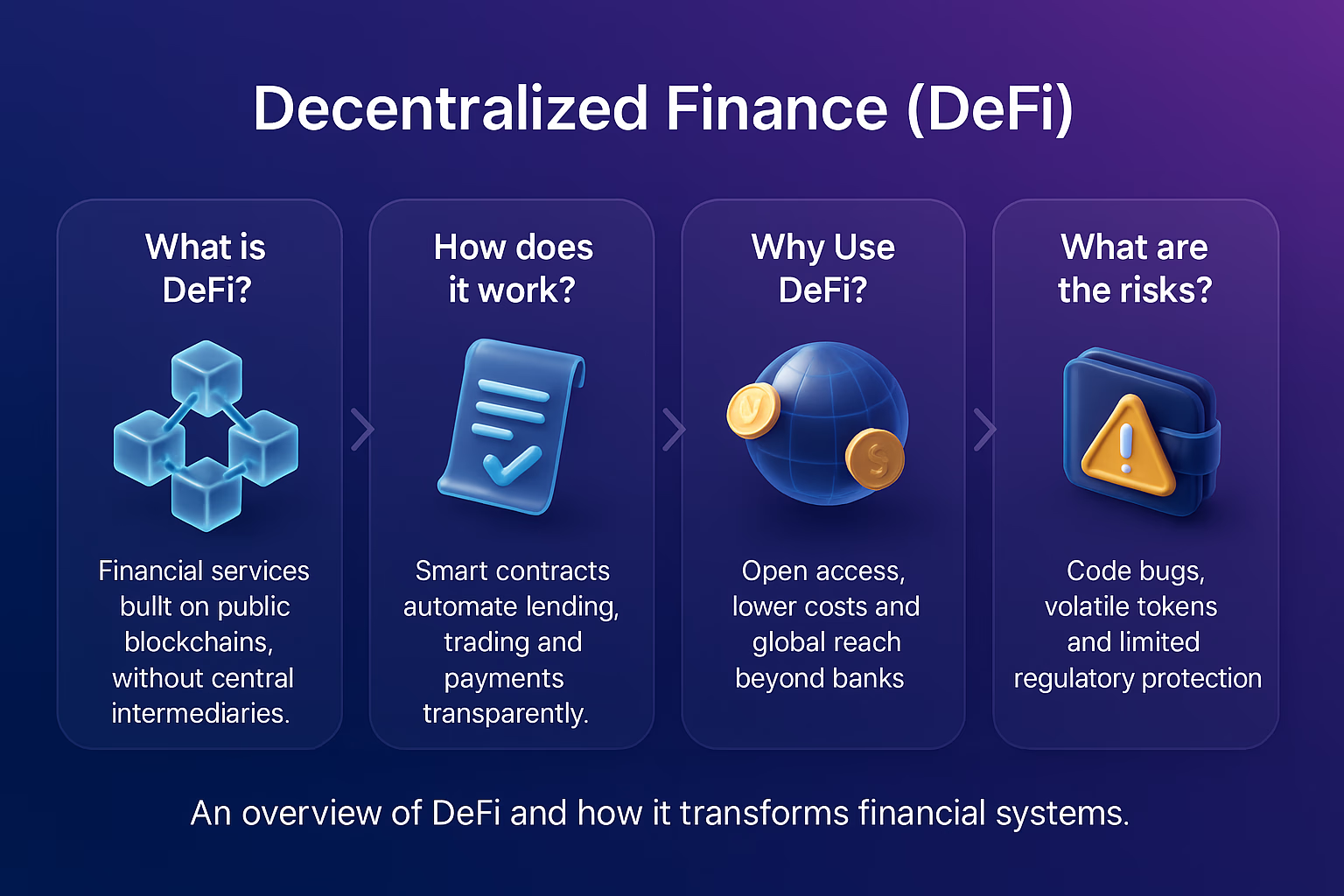
Decentralized finance — commonly referred to as DeFi — describes a class of financial applications built on public blockchain networks that execute financial functions through automated software protocols rather than centralised institutional intermediaries. The sector encompasses lending, borrowing, asset exchange, derivatives, and yield generation, all administered by self-executing code rather than licensed financial entities.
The emergence of DeFi represents a structurally distinct model from both traditional finance and the centralised cryptocurrency exchange sector. Where conventional banking relies on regulated institutions to hold assets, extend credit, and settle transactions, DeFi protocols perform these functions through smart contracts — programs deployed on blockchain networks that execute automatically when predefined conditions are satisfied. The World Bank and financial stability bodies including the Financial Stability Board (FSB) have identified DeFi as a category warranting dedicated regulatory analysis, reflecting its growing scale and systemic interconnections with broader crypto asset markets.
The sector’s growth has been accompanied by significant capital loss events, regulatory enforcement actions, and ongoing debate among policymakers about jurisdictional classification. Understanding DeFi’s architecture, mechanics, and risk profile is relevant to institutional observers, retail participants, regulators, and financial technologists navigating the digital asset landscape.
What Decentralized Finance Is: Definition and Core Distinction
The defining characteristic of DeFi is the replacement of institutional intermediaries with open-source, blockchain-deployed software protocols. In a traditional financial transaction, counterparty risk is managed through regulated institutions — a bank holds deposits, a clearinghouse settles trades, a custodian stores assets. These institutions carry licensing obligations, capital requirements, and consumer protection frameworks enforced by national regulators.
In DeFi, the intermediary function is performed by a smart contract: code that autonomously holds assets in escrow, calculates interest accrual, determines liquidation thresholds, and distributes returns according to rules encoded at deployment. The contract executes without human discretion. Participation requires only a compatible cryptocurrency wallet and an internet connection — no identity verification, credit assessment, or account approval.

This permissionless architecture is both DeFi’s principal innovation and its most significant risk vector. The same absence of gatekeeping that enables open access also eliminates the recourse mechanisms present in regulated financial systems. Transactions executed through smart contracts are final and irreversible on-chain; no dispute resolution body exists.
Core Protocol Categories and How They Function
DeFi activity is organised around several foundational protocol types, each addressing a distinct financial function.
Decentralised Exchanges (DEXs) — Decentralised exchanges facilitate peer-to-peer token swaps without a central order book or custodial intermediary. Most major DEXs, including Uniswap and Curve Finance, operate through automated market maker (AMM) algorithms. Rather than matching buyers and sellers directly, AMMs use liquidity pools — reserves of paired assets supplied by third-party liquidity providers — to price and execute trades algorithmically. The exchange rate is determined by a mathematical formula based on the ratio of assets in the pool, adjusting continuously with each trade.
Lending and Borrowing Protocols — Protocols such as Aave and Compound enable users to deposit crypto assets as collateral and borrow against that collateral at algorithmically determined interest rates. Rates adjust dynamically based on the utilisation ratio of each asset pool — the proportion of deposited assets currently borrowed. Borrowing positions are over-collateralised: users must post collateral exceeding the value of the loan, with automated liquidation triggered if the collateral ratio falls below a defined threshold. No credit history assessment occurs; the collateral itself is the sole credit mechanism.
Stablecoins — Stablecoins function as the primary medium of exchange within DeFi by providing price stability relative to fiat currencies, typically the US dollar. They fall into two structural categories: fiat-backed stablecoins, where each token is redeemable for a held fiat reserve (USDC, USDT), and crypto-collateralised algorithmic stablecoins, which maintain their peg through on-chain collateral and algorithmic supply adjustment mechanisms (DAI). The stability assumptions and failure modes differ materially between these categories, as demonstrated by the collapse of the TerraUST algorithmic stablecoin in May 2022, which resulted in rapid loss of the dollar peg and significant market contagion.
Yield Aggregators — Platforms such as Yearn Finance automate the deployment of user capital across multiple DeFi protocols to optimise yield, reallocating funds as rate conditions change. These protocols introduce additional smart contract dependency — a user interacting with a yield aggregator is exposed to the risk profile of every underlying protocol the aggregator interacts with.

The Role of Smart Contracts: Mechanics and Limitations
Smart contracts are the foundational infrastructure of DeFi. They are programs stored immutably on a blockchain that execute automatically when specified inputs or conditions are met, without requiring human authorisation at the point of execution.
In the DeFi context, smart contracts perform a range of functions that would otherwise require institutional intermediation: holding pooled liquidity, tracking individual user positions, calculating accrued interest, enforcing collateral ratios, executing liquidations, and distributing protocol fees. Because the contract code is publicly readable on-chain, any party can audit the logic governing their funds.
The immutability that makes smart contracts trustless also makes them difficult to remediate when vulnerabilities are discovered. Code errors that would be corrected through routine software updates in a centralised system can, in DeFi, be exploited before remediation is possible. According to blockchain security research firm Chainalysis, over $3 billion in crypto assets were lost to DeFi protocol exploits in 2022, representing the largest single category of crypto-related theft that year. Flash loan attacks — in which large uncollateralised loans are taken, used to manipulate protocol conditions, and repaid within a single transaction block — have been among the most sophisticated exploit vectors.
Major protocols typically commission independent smart contract audits prior to deployment, but audits identify known vulnerability patterns rather than guaranteeing security. Industry data indicates that audited protocols have been exploited, and that the pace of new protocol deployment frequently outstrips the capacity of the security audit market.
Risk Factors: A Structured Assessment
DeFi presents a risk profile that differs structurally from regulated financial products. Financial analysts and regulatory bodies have identified several principal categories.

Smart Contract Risk — Vulnerabilities in protocol code can result in immediate and irreversible loss of deposited funds. Unlike a bank account, there is no deposit insurance and no legal recourse in most jurisdictions. Governance upgrades to protocol code introduce additional risk windows.
Liquidation and Collateral Risk — Over-collateralised lending protocols rely on automated liquidation to maintain solvency. During periods of rapid price decline, cascading liquidations can occur as falling collateral values trigger simultaneous forced sales across many positions, accelerating price declines and widening losses beyond initial projections.
Impermanent Loss — Liquidity providers on AMM-based exchanges are exposed to impermanent loss: the opportunity cost incurred when the relative price of the two assets in a liquidity pool diverges from the price at the time of deposit. If the divergence is large enough, the fee income generated by providing liquidity may not offset the impermanent loss relative to simply holding the assets.
Oracle Risk — DeFi protocols depend on price oracles — data feeds that report external asset prices on-chain — to calculate collateral values and trigger liquidations. Oracle manipulation, whether through market activity or direct attack, can feed incorrect price data into protocol logic, enabling exploits. Several major DeFi attacks have targeted oracle vulnerabilities rather than the core contract logic.
Regulatory and Legal Risk — The regulatory classification of DeFi protocols and their governance token holders remains unresolved across most major jurisdictions. The US Securities and Exchange Commission (SEC) and Commodity Futures Trading Commission (CFTC) have each initiated enforcement actions against DeFi-related entities. The FSB has called for the application of the principle that equivalent financial activity should face equivalent regulation, regardless of the technology used to deliver it. Regulatory developments could materially affect the operational and legal status of specific protocols.
Custody Risk — DeFi users maintain direct custody of their assets through self-managed private keys. Loss of a private key, or interaction with a malicious contract, results in permanent, unrecoverable asset loss. There is no account recovery mechanism.
DeFi and Centralised Finance: Structural Comparison
Centralised finance (CeFi) platforms — including regulated cryptocurrency exchanges and digital asset custodians — provide a structurally different access model to crypto asset markets. CeFi platforms typically hold assets in custody on behalf of users, offer customer support, maintain compliance with KYC and AML obligations, and provide greater liquidity depth for large trades.
DeFi offers non-custodial access — users retain direct control of assets at all times — alongside permissionless participation and, in some market conditions, higher yields on deposited capital. These characteristics come with commensurate technical complexity and risk exposure.
Industry observers note that the two models serve different user profiles and use cases. CeFi platforms reduce operational complexity and provide consumer recourse, at the cost of custodial dependency and jurisdictional compliance requirements. DeFi preserves asset self-custody and open access, at the cost of smart contract exposure and the absence of institutional recourse.
Future Outlook
The DeFi sector continues to develop across several dimensions that will influence its trajectory. Layer 2 scaling solutions — secondary networks built atop base layer blockchains — have reduced transaction costs and increased throughput, lowering the barrier to participation and enabling more complex protocol interactions. Broader adoption of these scaling architectures is expected to continue.
Regulatory frameworks specific to DeFi are under active development in the European Union, through the Markets in Crypto-Assets (MiCA) regulation and supplementary guidance, and are under discussion in the United States and United Kingdom. The resolution of jurisdictional questions around protocol governance and developer liability will be material to institutional participation in the sector.
Institutional engagement with DeFi infrastructure, including permissioned DeFi environments designed to satisfy KYC and AML requirements while preserving smart contract execution, has been piloted by several financial institutions. Reports indicate this segment remains at an early stage, with significant legal and operational questions unresolved.
The interaction between DeFi protocols and central bank digital currency (CBDC) infrastructure is a subject of active research by multiple central banks, though practical integration remains prospective.
Decentralised finance represents a technically distinct approach to financial services delivery, replacing institutional intermediaries with blockchain-deployed smart contracts across lending, exchange, and yield generation functions. The sector’s permissionless architecture enables broad participation and non-custodial asset control but introduces risk categories — including smart contract exploits, oracle manipulation, and cascading liquidations — that differ structurally from those present in regulated financial markets. Regulatory frameworks governing DeFi remain under development across major jurisdictions. Financial analysts and policymakers continue to assess the sector’s systemic implications as its scale and interconnection with broader capital markets evolve.

