


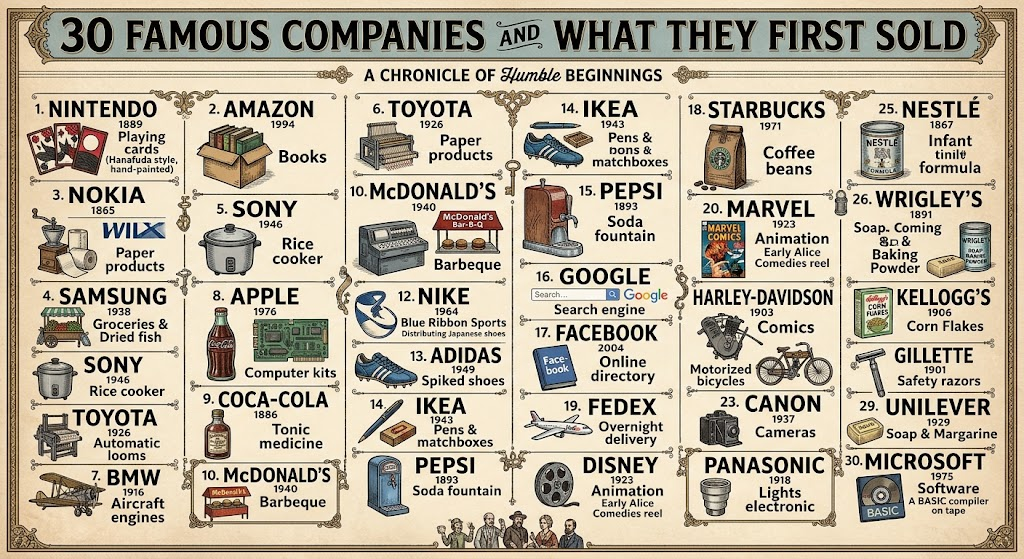
Many of today’s best-known global companies began with products or businesses that look surprisingly different from what they are known for today. Sony started with a rice cooker, Nokia entered business through paper products, Samsung operated as a grocery store, and Amazon initially focused on online bookselling.
The shift from an original product to a dominant modern business often reflects changes in technology, consumer demand and corporate strategy. The examples below highlight how companies evolved from relatively narrow beginnings into major global brands.
30 Famous Companies and Their Original Products
| Rank | Company | Original Product / Business |
|---|---|---|
| 1 | Sony | Rice cooker |
| 2 | Nokia | Toilet paper |
| 3 | Samsung | Grocery store |
| 4 | LEGO | Wooden toys |
| 5 | Nintendo | Playing cards |
| 6 | Nike | Track shoes |
| 7 | Lamborghini | Tractor |
| 8 | Colgate | Soap & candles |
| 9 | IKEA | Pens |
| 10 | LG | Facial cream |
| 11 | Tiffany & Co. | Stationery |
| 12 | Toyota | Automatic loom |
| 13 | Amazon | Online bookstore |
| 14 | Apple | Apple Computer I |
| 15 | Search engine | |
| 16 | Intel | Memory chip |
| 17 | BMW | Aircraft engine |
| 18 | Canon | Camera |
| 19 | Coca-Cola | Syrup |
| 20 | Ford | Quadricycle |
| 21 | Harley-Davidson | Racer motorcycle |
| 22 | HP | Audio oscillator |
| 23 | Honda | Bicycle auxiliary engine |
| 24 | L’Oréal | Hair dye |
| 25 | Renault | Renault Voiturette |
| 26 | Hoover | Leather goods |
| 27 | McDonald’s | Hot dogs |
| 28 | Pixar | Image Computer |
| 29 | Nestlé | Baby formula |
| 30 | Wrigley | Soap & baking powder |
Sony Started With a Rice Cooker
Sony is now associated with televisions, cameras, gaming, audio equipment and electronics. Its early history was less successful. The company, founded in Japan as Tokyo Tsushin Kenkyujo in 1946, attempted to sell a rice cooker among its early products.
The rice cooker reportedly failed to produce consistent results, illustrating an important point about corporate history: a company’s first commercial product does not necessarily predict its eventual area of expertise.
Nokia Once Sold Paper Products
Nokia is now strongly associated with mobile phones and telecommunications equipment, but its origins were far removed from consumer electronics.
The company began in Finland in the 19th century as a pulp and paper business. Paper products, including toilet paper, were part of its early industrial operations before Nokia expanded into rubber, cables, electronics and eventually telecommunications.
Samsung Began as a Grocery Business
Samsung’s modern identity is built around smartphones, semiconductors, televisions and other electronics. Its original business was considerably more conventional.
Founded in 1938, Samsung began as a trading company dealing in groceries and other goods. Over subsequent decades, it diversified into food processing, textiles, insurance, retail and electronics.
LEGO Started With Wooden Toys
LEGO is synonymous with its interlocking plastic bricks, but those were not its first toys.
The Danish company began producing wooden toys before developing the plastic construction system that ultimately became its defining product. The company’s transition demonstrates how a recognizable brand can emerge from an earlier, broader toy-making business.
Nintendo Predates Video Games
Nintendo is one of the world’s most recognizable video-game companies, but video games were not part of its original business.
Founded in Kyoto in 1889, Nintendo initially produced traditional Japanese playing cards. Its later diversification eventually took it into toys, arcade games and home video-game systems.
Nike Started With Track Shoes
Nike grew out of a business relationship involving Bill Bowerman and Phil Knight and initially sold athletic footwear under the Blue Ribbon Sports name.

Track shoes were central to its early footwear business. The company later adopted the Nike name and expanded from specialized running footwear into a global sportswear brand.
Lamborghini Originally Built Tractors
Lamborghini is now identified with high-performance sports cars. Its founder, Ferruccio Lamborghini, originally built agricultural machinery.
The company’s tractor business preceded the establishment of Automobili Lamborghini in 1963. The move into sports cars ultimately created the luxury automotive brand known worldwide today.
Colgate Began With Soap and Candles
Colgate is best known for toothpaste and oral-care products, but its early business was broader.
William Colgate established a soap, starch and candle business in New York in the early 19th century. Toothpaste became an increasingly important part of the company’s portfolio much later.
IKEA’s Early Business Included Pens
IKEA is now one of the world’s largest furniture retailers. Its founder, Ingvar Kamprad, began selling a range of small consumer goods.
Pens were among the products sold during IKEA’s early mail-order period. Furniture gradually became the company’s central business, eventually producing the flat-pack model for which IKEA is known.
LG Started With Cosmetics
LG’s corporate history began in South Korea with businesses involving chemicals and consumer products. One notable early consumer product was facial cream.
The company later expanded into household appliances, electronics and other technology businesses, eventually becoming one of South Korea’s major global brands.
Toyota Began With Textile Machinery
Toyota’s roots lie in the textile industry rather than automobiles.
Sakichi Toyoda developed automatic looms, and the machinery business provided the industrial foundation from which Toyota Motor Corporation later emerged. Automotive manufacturing eventually became the group’s defining global business.
Amazon Began as an Online Bookstore
Amazon’s original business is one of the clearest examples of a company expanding far beyond its initial market.
When Jeff Bezos launched Amazon in 1994, the company focused on selling books online. Books were relatively well suited to e-commerce because of their large catalogs and standardized products. Amazon subsequently expanded into electronics, household goods, cloud computing, advertising and numerous other businesses.
Apple Began With the Apple Computer I
Apple’s first major commercial product was the Apple I, a personal computer designed by Steve Wozniak and marketed by Steve Jobs and the company’s early team.
The company later built its business around the Macintosh, iPod, iPhone, iPad, Mac and services. The original Apple I nevertheless marked the beginning of one of the world’s most valuable technology companies.
Google Started With Search
Google’s original focus is much closer to its modern identity than many of the other companies on this list.
The company emerged from a search-engine project developed by Larry Page and Sergey Brin at Stanford University. Its search technology became the foundation for a much broader internet business spanning advertising, cloud services, software, hardware and artificial intelligence.
Intel Initially Focused on Memory Chips
Intel was founded in 1968 and initially concentrated on semiconductor memory.
Its business later shifted heavily toward microprocessors, particularly after the company’s development of processors for the emerging personal-computer industry. Intel subsequently became one of the defining companies of the semiconductor sector.
BMW Made Aircraft Engines
BMW’s early industrial history is closely connected with aviation.
The company produced aircraft engines before becoming primarily associated with automobiles and motorcycles. Its transition into automotive manufacturing eventually produced the BMW brand known globally for passenger cars and motorcycles.
Canon Began With Cameras
Canon’s original business was much closer to its modern identity than some of the other companies in this list.
The Japanese company developed cameras before expanding into office equipment, printers, imaging technologies and other products. Photography and imaging remained central to the company’s identity for decades.
Coca-Cola Began as a Syrup
Coca-Cola’s original commercial product was the syrup used to make its famous beverage.
The Coca-Cola formula was developed in Atlanta in the late 19th century. The company’s growth subsequently came through the production, distribution and marketing of the finished soft drink, transforming the brand into a global beverage business.
Ford’s First Vehicle Was the Quadricycle
Before the Ford Motor Company became synonymous with mass-produced automobiles, Henry Ford built experimental vehicles.

His 1896 Quadricycle was his first successful gasoline-powered automobile. Ford’s later manufacturing innovations, particularly moving assembly-line production, fundamentally changed the economics of automobile manufacturing.
HP Started With an Audio Oscillator
Hewlett-Packard began in a Palo Alto garage in 1939 with electronic test equipment.
One of its earliest products was an audio oscillator, an electronic instrument used to generate audio-frequency signals. HP later expanded into computers, printers, measurement equipment and enterprise technology.
Honda’s Early Product Was a Bicycle Engine
Honda’s early postwar business focused on small engines and motorized bicycles.
The company developed auxiliary engines that could be attached to bicycles, helping meet demand for affordable transportation in postwar Japan. Honda subsequently expanded into motorcycles, automobiles, power equipment and other mobility products.
L’Oréal Began With Hair Dye
L’Oréal’s roots are in cosmetics, but specifically in hair-color products.
Chemist Eugène Schueller founded the company in France in 1909 after developing hair-dye products for professional use. The business later expanded into a much broader portfolio of cosmetics, skincare, haircare and beauty brands.
Renault’s First Car Was the Voiturette
Renault was founded by Louis, Marcel and Fernand Renault in France in the late 19th century.
One of its earliest automobiles was the Renault Voiturette, a small vehicle that helped establish the company as an automobile manufacturer. Renault later became a major European automotive group.
Hoover Was Connected to Leather Goods
Hoover became famous for vacuum cleaners, but its corporate history has a less obvious connection to leather products.
The company’s early commercial history included leather goods before it became associated with electric vacuum cleaners. The vacuum-cleaner business ultimately became the defining identity of the Hoover brand.
McDonald’s Wasn’t Originally About Burgers
McDonald’s is now one of the world’s best-known fast-food chains, but its early restaurant business was broader than the modern menu suggests.
The McDonald brothers operated a drive-in restaurant before developing the faster, simplified service model that became the foundation of McDonald’s. Hot dogs were among the foods associated with the brothers’ early food-service operations.
Pixar Originally Developed Computer Imaging Technology
Pixar is best known for animated films such as Toy Story, but its origins lie in computer graphics technology.
Before becoming a film studio, Pixar developed the Pixar Image Computer and related computer-imaging technology. The company later shifted toward computer animation and feature films, ultimately becoming a major force in modern animation.
Nestlé’s Early Success Came From Infant Food
Nestlé’s history began with food products rather than the enormous portfolio associated with the company today.
Henri Nestlé developed an infant-food product in the 1860s designed as an alternative food for infants who could not be breastfed. The success of that product helped establish the business that eventually became Nestlé.
Wrigley Started With Soap and Baking Powder
Wrigley is now strongly associated with chewing gum, including brands such as Juicy Fruit and Doublemint.
The company’s founder, William Wrigley Jr., originally sold soap and baking powder. Chewing gum became a promotional product associated with those sales and eventually became the company’s primary business.
Why Companies Change Their Core Products
These histories reveal several recurring patterns.
Companies Follow Growing Markets
Businesses often begin by serving a narrow market and then move toward products with greater demand or stronger margins. Amazon’s transition from books to a broad e-commerce and cloud-services platform is an extreme example.
Technology Can Create Entirely New Opportunities
Intel, HP, Pixar and Google benefited from technological changes that created new markets. Their original products were stepping stones toward businesses that were significantly larger than their starting operations.
Early Products Can Reveal the Founder’s Capabilities
Toyota’s textile machinery expertise provided an industrial foundation for automobile production. Honda’s small-engine work similarly developed capabilities that could later be applied to motorcycles and automobiles.
Brand Identity Can Outlive the Original Business
Nintendo’s playing cards, Nokia’s paper products and Wrigley’s early consumer goods are far removed from how consumers commonly understand those companies today.
What These Company Histories Tell Us
The biggest lesson is that a company’s first product is not necessarily its most important asset. Manufacturing expertise, distribution networks, engineering capabilities, branding and customer relationships can be transferred into entirely different markets.
Some companies gradually expanded from their original businesses. Others made much more dramatic pivots. In both cases, the modern brand often represents only one stage of a much longer corporate history.
Conclusion
The histories of these 30 famous companies show how dramatically businesses can evolve. Sony moved beyond early consumer experiments into electronics and entertainment; Nokia shifted from paper and industrial products toward telecommunications; Amazon expanded from books into a diversified technology and commerce company; and Nintendo transformed from a playing-card maker into a video-game giant.
These examples also come with an important historical caveat: “first product” can mean different things depending on whether it refers to the company’s founding business, first manufactured product, first successful commercial product or first product associated with its modern corporate identity. The table should therefore be treated as a concise historical overview rather than a strict apples-to-apples ranking.

