


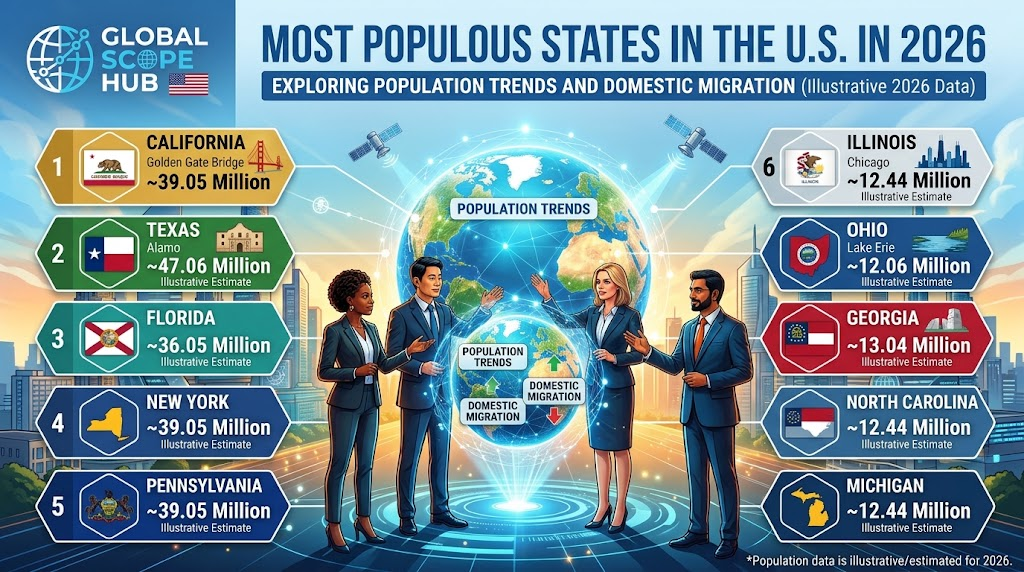
California remains the most populous state in the United States in 2026, with an estimated 39.43 million residents, according to the supplied World Population Review dataset. Texas ranks second at 31.29 million, while Florida is third with 23.37 million.
The population gap between the largest states and the smallest is substantial. California has more than 66 times the population of Wyoming in the supplied estimates. The ranking also shows the continued concentration of the U.S. population in a relatively small group of large states, with 10 states exceeding 10 million residents.
Data note: The supplied graphic contains two ranking inconsistencies: West Virginia is listed at rank 48 despite a population of 1,775,156, and Idaho is listed at rank 50 despite a population of 2,402,598. Their populations would place them substantially higher. The table below preserves the supplied population figures but corrects the numerical ranking based on those figures.
Top 10 Most Populous States in America
California leads the country with nearly 39.5 million residents. Texas follows with more than 31.2 million, creating a gap of about 8.1 million people between the first- and second-largest states.
Florida, New York and Pennsylvania complete the top five. Illinois, Ohio, Georgia, North Carolina and Michigan round out the 10 states with populations above 10 million.
| Rank | State | Population, 2026 |
|---|---|---|
| 1 | California | 39,431,263 |
| 2 | Texas | 31,290,831 |
| 3 | Florida | 23,372,215 |
| 4 | New York | 19,867,248 |
| 5 | Pennsylvania | 12,961,683 |
| 6 | Illinois | 12,710,158 |
| 7 | Ohio | 11,780,017 |
| 8 | Georgia | 11,029,227 |
| 9 | North Carolina | 11,016,226 |
| 10 | Michigan | 10,140,239 |
California
With 39,431,263 residents, California is the largest state by population in the supplied 2026 estimates. Its population is roughly 26% higher than Texas’s.
California’s size reflects decades of population growth supported by major metropolitan areas, technology and business centers, international migration, agriculture and a large service economy.

Texas
Texas ranks second with 31,290,831 residents. Its population is roughly 8.1 million below California but nearly 8 million above Florida.
The state’s major metropolitan areas, large land area and diversified economy make Texas one of the country’s most important population and economic centers.
Florida
Florida has the third-largest population at 23,372,215. It is the only state other than California and Texas in the supplied dataset with more than 20 million residents.
Florida’s population is concentrated heavily in metropolitan areas along both coasts and around central Florida.
States Ranked 11 to 20
The next group includes several major population centers in the Northeast, South and Midwest.
| Rank | State | Population, 2026 |
|---|---|---|
| 11 | New Jersey | 9,500,851 |
| 12 | Virginia | 8,761,012 |
| 13 | Washington | 7,957,611 |
| 14 | Arizona | 7,581,025 |
| 15 | Massachusetts | 7,126,351 |
| 16 | Indiana | 6,997,535 |
| 17 | Tennessee | 6,929,744 |
| 18 | Missouri | 6,177,957 |
| 19 | Maryland | 6,165,129 |
| 20 | Wisconsin | 5,951,400 |
New Jersey is the first state below the 10-million threshold in the supplied estimates. Virginia, Washington, Arizona and Massachusetts each exceed 7 million residents.
Indiana, Tennessee, Missouri, Maryland and Wisconsin form the lower portion of this group, with each state approaching or exceeding 6 million people.

States Ranked 21 to 30
| Rank | State | Population, 2026 |
|---|---|---|
| 21 | Colorado | 5,957,493 |
| 22 | Minnesota | 5,793,151 |
| 23 | South Carolina | 5,373,555 |
| 24 | Alabama | 5,237,958 |
| 25 | Kentucky | 5,186,750 |
| 26 | Louisiana | 4,657,757 |
| 27 | Oklahoma | 4,534,795 |
| 28 | Oregon | 4,301,089 |
| 29 | Connecticut | 3,617,176 |
| 30 | Iowa | 3,246,850 |
Colorado and Minnesota are both just below 6 million residents. South Carolina, Alabama and Kentucky each have populations above 5 million.
Iowa closes the top 30 with approximately 3.25 million residents.
States Ranked 31 to 40
| Rank | State | Population, 2026 |
|---|---|---|
| 31 | Kansas | 2,946,053 |
| 32 | Nevada | 2,940,058 |
| 33 | Utah | 2,817,345 |
| 34 | Mississippi | 2,755,149 |
| 35 | Arkansas | 2,673,400 |
| 36 | Nebraska | 2,631,576 |
| 37 | New Mexico | 2,130,424 |
| 38 | Hawaii | 1,455,271 |
| 39 | New Hampshire | 1,402,054 |
| 40 | Maine | 1,395,722 |
Kansas and Nevada are almost identical in population in the supplied data, at about 2.94 million each.
Utah, Mississippi, Arkansas and Nebraska fall between approximately 2.6 million and 2.8 million. New Mexico is the only state in this group above 2 million but below 2.2 million.
Hawaii, New Hampshire and Maine each have fewer than 1.5 million residents.
States Ranked 41 to 50
The supplied graphic contains ranking errors for Idaho and West Virginia. Reordering these states by the population figures supplied produces the following sequence:
| Corrected Rank | State | Population, 2026 |
|---|---|---|
| 41 | Idaho | 2,402,598 |
| 42 | Montana | 1,136,760 |
| 43 | West Virginia | 1,775,156 |
| 44 | Rhode Island | 1,095,962 |
| 45 | Delaware | 1,046,051 |
| 46 | South Dakota | 909,824 |
| 47 | North Dakota | 783,926 |
| 48 | Alaska | 770,337 |
| 49 | Vermont | 647,464 |
| 50 | Wyoming | 595,309 |
There is an additional ordering issue in this portion of the supplied graphic: West Virginia’s 1,775,156 residents would place it above Montana, while Idaho’s 2,402,598 would place it above both.

Wyoming is the least populous state in the supplied 2026 estimates, with 595,309 residents, followed by Vermont at 647,464 and Alaska at 770,337.
California Has More Than Twice Florida’s Population
The three largest states have a particularly large demographic footprint.
California’s estimated population of 39.43 million is approximately:
- 1.26 times Texas’s population
- 1.69 times Florida’s population
- 1.98 times New York’s population
- 3.04 times Pennsylvania’s population
Together, California, Texas and Florida account for roughly 94.1 million residents based on the supplied figures.
That is more than the combined population of many groups of smaller states, illustrating how heavily U.S. population is concentrated in its largest states.
10 States Have More Than 10 Million Residents
The supplied estimates put 10 states above the 10-million mark:
- California — 39.43 million
- Texas — 31.29 million
- Florida — 23.37 million
- New York — 19.87 million
- Pennsylvania — 12.96 million
- Illinois — 12.71 million
- Ohio — 11.78 million
- Georgia — 11.03 million
- North Carolina — 11.02 million
- Michigan — 10.14 million
The threshold becomes much less common below the top 10. New Jersey, at 9.50 million, is the next-largest state but remains below 10 million.

Population Differences Matter for the U.S. Economy
Population rankings have implications beyond demographics. Population size influences congressional representation, electoral votes, consumer markets, labor supply, housing demand, infrastructure requirements and the scale of state and local government.
However, population alone does not determine economic importance. A smaller state can have substantial economic output because of higher incomes, specialized industries, energy production, finance, technology or other factors.
Population estimates also should not be interpreted as precise headcounts. Estimates can change as new administrative records, surveys, births, deaths and migration data become available.
Methodology and Data Limitations
The figures above come from the World Population Review dataset supplied with the ranking. They should be treated as 2026 population estimates rather than official decennial census counts.
The source graphic also contains clear ordering inconsistencies. In particular:
- Idaho: 2,402,598 residents but displayed as rank 50.
- West Virginia: 1,775,156 residents but displayed as rank 48.
- Based strictly on the supplied population figures, both should appear substantially earlier in the ranking.
This matters because a population ranking should be sorted by the population values themselves. Correcting the sequence does not change the supplied population figures; it only makes the ranking internally consistent.
Conclusion
California remains the largest state in the supplied 2026 U.S. population estimates, followed by Texas and Florida. New York, Pennsylvania and Illinois form the next tier, while Georgia and North Carolina have both crossed the 11-million mark.
At the other end of the distribution, Wyoming, Vermont and Alaska have fewer than 800,000 residents. The enormous difference between the largest and smallest states demonstrates the highly uneven geographic distribution of the U.S. population.
Because these are estimates rather than a single nationwide census count, the figures can change as demographic data are revised. The ranking should therefore be viewed as a 2026 population snapshot rather than a permanent ordering.

