


International work experience can influence both professional development and personal growth. Living and working in another country exposes people to different workplace practices, cultures, languages and social environments while requiring them to adapt to circumstances that may be unfamiliar.
For students, recent graduates and established professionals, an international experience can also add a broader dimension to a career profile. Depending on the role and destination, working abroad may provide exposure to international customers, multinational teams, new technologies, different management practices and overseas markets.
The value of international experience, however, depends on the nature of the work and what an individual learns from it. Simply living abroad does not automatically improve career prospects. The strongest professional benefit comes when the experience develops skills, knowledge or networks that can be demonstrated to future employers.
What Is International Work Experience?
International work experience refers to professional or work-related experience gained outside a person’s home country.
It can range from a short internship or seasonal position to several years of employment with an overseas company. International experience can also be gained through teaching, volunteering, university programs, professional exchanges and other structured opportunities.
For someone planning a career abroad, the experience can provide exposure to how organizations operate across different markets while also developing personal skills that may be transferable to future roles.
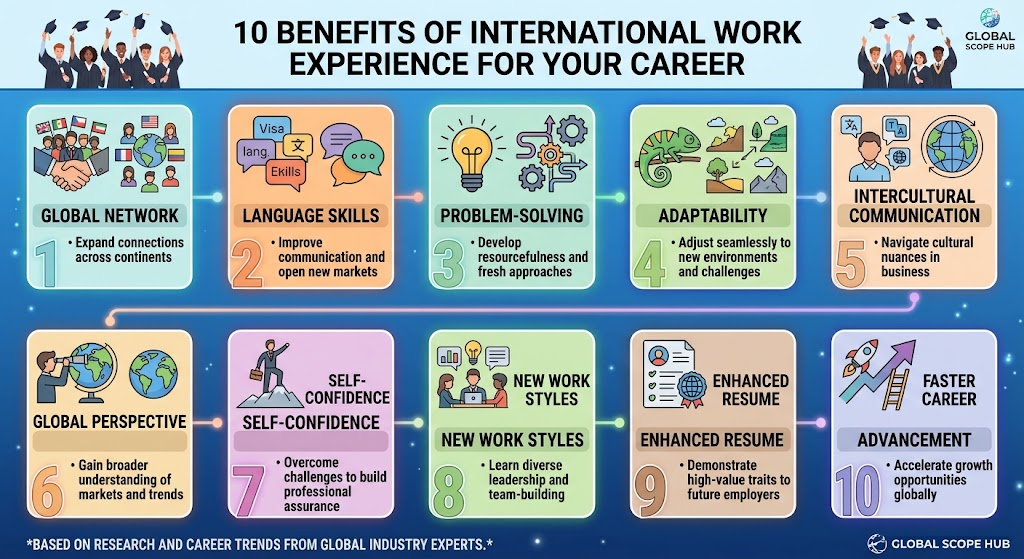
10 Benefits of International Experience
1. Personal Growth and Independence
Moving to another country often requires people to manage responsibilities without the familiar support systems they have at home.
Everyday activities such as navigating transportation, communicating with unfamiliar people, managing finances and understanding local procedures can require independent decision-making.
Over time, these experiences may strengthen:
- Independence
- Decision-making
- Problem-solving
- Organization
- Self-management
- Resilience
- Adaptability
The extent of personal growth varies from person to person, but living outside a familiar environment can create opportunities to identify strengths and areas where additional development is needed.
2. Professional Skill Development
International employment can provide opportunities to develop both technical and interpersonal skills.
Working in a different country may require employees to adapt to new workplace expectations, management styles and communication practices.
Problem-solving
Unfamiliar systems and environments can require workers to identify solutions without relying on established routines.
Adaptability
Employees working across different cultural or organizational environments may need to adjust their approach when circumstances change.
Teamwork
International workplaces can bring together employees with different languages, professional backgrounds and perspectives. Learning to collaborate across those differences can strengthen teamwork skills.
Leadership
Managing responsibilities independently in a new environment can provide opportunities to develop initiative and self-management, although international experience by itself does not necessarily constitute formal leadership experience.
Other potentially transferable skills include critical thinking, empathy, creativity, decision-making and initiative.

3. Building an International Professional Network
Working abroad can expand a person’s professional network beyond their home country.
Colleagues, managers, clients, suppliers, professional associations and other contacts can become part of a broader international network.
These relationships may provide access to information about:
- Employment opportunities
- Industry developments
- International companies
- Professional events
- New markets
- Cross-border projects
The value of a network depends largely on maintaining meaningful professional relationships after the international assignment ends.
4. Greater Cultural Awareness
Working and living abroad places people in environments where social norms, workplace expectations and communication styles may differ from those they know at home.
Regular interaction with people from different backgrounds can help professionals become more aware of cultural differences.
This can be particularly relevant to companies operating across multiple countries, where employees may communicate with international colleagues, customers or business partners.
Cultural awareness does not mean assuming that everyone from a particular country behaves in the same way. Instead, it involves learning to recognize differences and adapting communication appropriately.
5. Stronger Communication Skills
International environments can require employees to communicate with people who have different linguistic and cultural backgrounds.
Even when a common language is used, accents, terminology, communication styles and nonverbal signals can vary.
These circumstances can encourage professionals to communicate more clearly, listen carefully and confirm that information has been understood.
For companies operating internationally, the ability to communicate effectively across cultures can be relevant to roles involving customers, suppliers, colleagues and overseas markets.
6. Increased Confidence Through New Experiences
Relocating to another country can involve a series of unfamiliar situations.
Finding accommodation, navigating a new city, understanding workplace procedures and establishing new social and professional relationships can require initiative.
Successfully managing these situations may increase a person’s confidence in handling unfamiliar circumstances.
However, confidence gained from international experience is most useful professionally when it can be demonstrated through specific examples. A candidate might explain how they solved a problem, adapted to a new working environment or managed responsibilities independently.
7. Language Development
Living in another country can create opportunities to learn or strengthen a second language.
The level of improvement depends on factors such as the amount of exposure, the language used at work, the local environment and the individual’s effort.
Language skills can be relevant in careers involving:
- International business
- Customer service
- Tourism and hospitality
- Education
- Diplomacy
- Sales
- Marketing
- Translation
- International development
Multilingual ability can also make it possible to communicate with customers or colleagues who use another language.
8. Stronger Resume and Professional Profile
International experience can become a useful part of a resume when it demonstrates specific skills or achievements.
Rather than simply writing that they “worked abroad,” candidates can describe what they actually accomplished.
For example, an international role might demonstrate:
- Cross-cultural communication
- Project coordination
- Language skills
- International customer service
- Independent decision-making
- Team collaboration
- Market knowledge
- Adaptability
- Leadership responsibilities
The most useful resume descriptions connect the overseas experience to measurable responsibilities or outcomes.
9. Access to Different Career Opportunities
International experience can expose professionals to industries, employers and markets they may not encounter in their home country.
Some careers also have a strong international component. Professionals with experience across countries may be considered for roles involving international clients, regional operations, global supply chains or multinational teams.
Language ability and familiarity with overseas markets can also be relevant qualifications for certain positions.
International experience does not guarantee better employment opportunities, however. Employers will generally assess the relevance of the experience alongside qualifications, skills and the requirements of the position.
10. Broader Life Experience
The impact of international experience extends beyond employment.
Living abroad can expose people to different communities, food, traditions, social environments and ways of approaching everyday life.
These experiences may influence personal interests, relationships, career goals and future decisions.
For some people, an international assignment may also clarify whether they want to build a long-term career abroad or return to their home country with new skills and experiences.
How International Experience Can Affect Your Career
The professional value of working abroad often depends on three factors: what you did, what you learned and how relevant those experiences are to your next career step.
For example, a marketing professional who works with customers in another market may develop international market knowledge. A software professional may work within a distributed multinational team. A teacher may develop classroom experience in a different education system.

These experiences can be more meaningful to an employer when the candidate can explain how they contributed to measurable results or developed skills relevant to the new position.
International experience should therefore be viewed as an opportunity to build career capital rather than as a qualification that automatically produces better employment outcomes.
Ways to Gain International Experience
International experience does not necessarily require a multi-year overseas employment contract.
People can gain exposure to international environments through programs lasting several months, a semester, a year or longer.
Study Abroad
University students can participate in study-abroad programs that allow them to spend part of their education in another country.
These programs can combine academic study with exposure to another culture and education system.
Teaching English Abroad
People who meet the requirements of particular programs can pursue English-language teaching opportunities overseas.
Some positions require recognized teaching or language-teaching qualifications, while requirements vary by country and employer.
International Internships
Internships can provide students and recent graduates with professional experience in another country.
An international internship can combine practical workplace exposure with cultural and professional learning.
Volunteering
Nonprofit organizations, charities and community projects can provide opportunities to work with international teams or communities.
Volunteering can be particularly relevant to people interested in international development, humanitarian work, education or community programs.
Global Learning Programs
Universities, professional organizations and other institutions may offer international learning programs, exchanges and short-term professional opportunities.
These can provide international exposure without requiring participants to relocate permanently.
Taking a Period Abroad After Graduation
Some graduates choose to spend a defined period living and working abroad before establishing a long-term career.
This can provide an opportunity to test a new environment, build professional experience and develop international contacts.
How to Make International Experience More Valuable
Simply listing an overseas job on a resume may not communicate its full value.

Professionals returning from abroad can document specific accomplishments and skills developed during their time overseas.
Useful questions include:
- What responsibilities did I have?
- What problems did I solve?
- Which new skills did I develop?
- Did I work with international teams?
- Did I communicate in another language?
- Did I manage customers or projects across borders?
- What measurable results did I achieve?
- How does this experience relate to my next career goal?
Answering these questions can turn a general statement about “working abroad” into evidence of professional development.
Challenges and Limitations of Working Abroad
International experience can provide significant opportunities, but it can also involve challenges.
Relocation may require employees to adjust to different labor laws, workplace cultures, languages, housing markets, transportation systems and social environments.
Financial costs can also be significant. Moving expenses, accommodation, insurance, transportation and visa-related costs can affect the overall value of an overseas opportunity.
There can also be professional limitations. Some international roles may provide little additional career value if the work is unrelated to a person’s long-term objectives.
For this reason, people considering overseas work should evaluate the actual responsibilities and learning opportunities rather than focusing only on the destination.
International Experience and the Future of Global Careers
As businesses operate across increasingly interconnected markets, professionals may encounter international teams, customers and suppliers even when they work from their home country.
International experience can therefore be one way to develop skills relevant to cross-border work.
Its relevance is particularly visible in areas such as technology, finance, consulting, logistics, international development, education, healthcare, media and global commerce.
The broader trend toward international collaboration also means that professionals can gain some global experience without permanently relocating. Remote teams, international projects and cross-border clients can expose workers to different markets while they remain in their home countries.
Conclusion
International experience can contribute to personal development, professional skills, cultural awareness, language ability and global networking. It can also provide exposure to different industries, organizations and markets.
However, the career value of working abroad depends on the quality and relevance of the experience. A position that provides meaningful responsibilities, transferable skills and professional connections may have greater long-term value than simply spending time in another country.
For students, graduates and professionals considering an international career, study programs, internships, teaching opportunities, volunteering and overseas employment can provide different entry points into the global workforce.
Ultimately, international experience is most useful when it can be translated into demonstrable skills, achievements and knowledge that remain relevant after the person returns home or moves to another international market.

