


Introduction
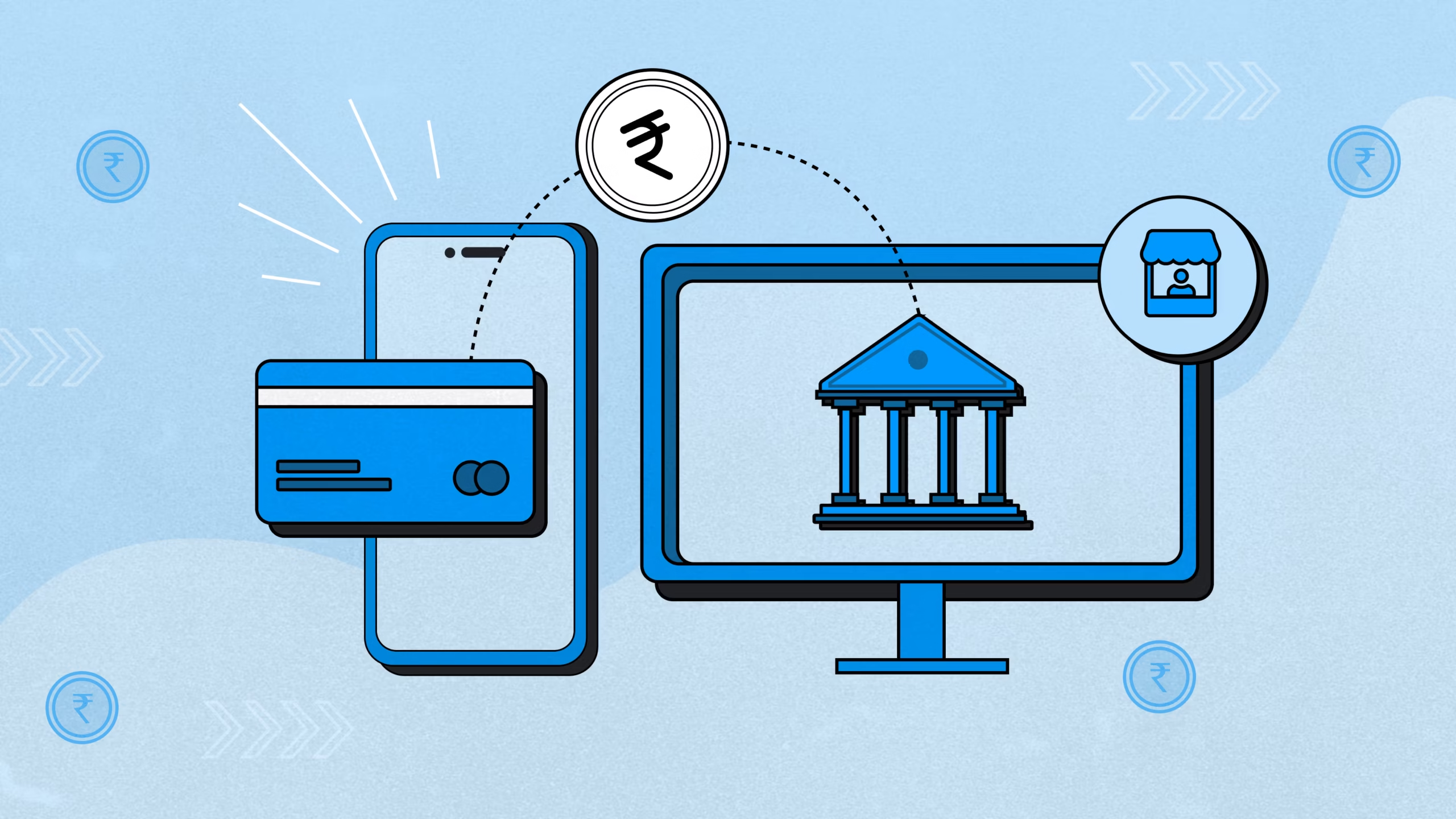
A payment gateway is the technology interface that captures, encrypts, and transmits customer payment credentials from a merchant’s point-of-sale system or e-commerce platform to the payment processing network for authorisation. It constitutes the front-end layer of the electronic payment chain — the component with which consumers interact directly when completing a transaction, whether at a physical terminal, a website checkout, or a mobile payment interface.
Payment gateways have undergone significant technical evolution since their introduction as basic magnetic stripe card readers. Contemporary gateway systems support chip-and-PIN authentication, contactless near-field communication transactions, QR code-based payments, and API-connected online payment portals. That evolution reflects both shifts in consumer payment behaviour and the progressive digitisation of commerce across retail, e-commerce, and mobile channels.
The global payment processing market — of which gateway services form a foundational component — was estimated at $71.5 billion in 2026 and is projected to reach $122 billion by 2031, according to industry forecasts. Understanding how payment gateways function, how they differ from payment processors, and what cost and architectural considerations govern their selection is directly relevant for businesses designing or evaluating their payment infrastructure.
What a Payment Gateway Does and How It Differs from a Payment Processor
The payment gateway and the payment processor are distinct components of the transaction chain that operate sequentially, each handling a different phase of the payment lifecycle. The distinction is frequently conflated in commercial descriptions of payment products, but the functional difference is material.
The payment gateway is responsible for the data collection and transmission phase. When a customer presents payment credentials — by inserting a chip card, tapping a contactless device, or entering card details into an online form — the gateway captures that data, encrypts it, and transmits it to the payment processor. The gateway does not execute the funds transfer; its function ends at the point of secure data handoff.
The payment processor receives the encrypted data from the gateway and manages the authorisation and settlement phases. It routes the transaction request to the relevant card network — Visa, Mastercard, American Express, or an equivalent — which forwards the request to the issuing bank for approval. The issuing bank returns an authorisation or decline response through the same chain, and the processor communicates the outcome back to the merchant via the gateway.

In summary: the gateway handles data collection and encryption; the processor handles the financial transaction mechanics. Some market participants — including PayPal, Stripe, and Square — bundle both functions under a single product offering, which has contributed to the terminological overlap in how these services are described commercially.
Gateway Architecture: In-Store Versus Online Payment Environments
The technical architecture of a payment gateway differs depending on the transaction environment in which it operates.
In-Store Payment Gateways
Physical retail gateways consist of point-of-sale terminal hardware connected to the payment processing network via an internet connection or, in legacy installations, a telephone line. Terminal technology has progressed through several generations. Early systems relied on magnetic stripe readers and customer signature verification. The subsequent adoption of EMV chip technology — named after its developers Europay, Mastercard, and Visa — replaced signature verification with PIN entry, improving transaction security. The Luhn algorithm, a standard checksum formula, is applied to verify the mathematical validity of card numbers entered into POS terminals.
Contactless payment functionality, enabled by near-field communication technology, allows customers to complete transactions by tapping a card or mobile device against a terminal reader. The integration of digital wallets — including Apple Pay, Google Wallet, and Samsung Pay — into the contactless payment flow has extended this capability, allowing consumers to authenticate transactions using encrypted card credentials stored on their devices rather than presenting a physical card.
Online Payment Gateways
E-commerce payment gateways operate through application programming interfaces, or APIs, that enable merchant websites and applications to communicate with payment processing networks. When a customer completes a checkout form on a merchant’s website, the gateway API transmits the encrypted payment data to the processor without requiring the merchant’s systems to store raw card credentials — a design that limits the merchant’s PCI DSS compliance obligations.

Hosted payment page configurations redirect the customer to a gateway-controlled interface for credential entry, further isolating the merchant’s infrastructure from direct exposure to cardholder data. Direct API integrations, by contrast, allow the merchant to maintain the customer interface while transmitting data to the gateway in the background, providing a more seamless user experience at the cost of greater compliance responsibility.
Market Structure: Bank-Operated Gateways, Independent Providers, and Payment Facilitators
Merchants access payment gateway services through two primary channels: acquiring bank partnerships and independent gateway providers.
Large financial institutions — including Bank of America and JPMorgan Chase — operate proprietary payment gateway systems available to their merchant banking clients alongside acquiring services. This model provides a consolidated relationship between gateway and acquirer but may offer less flexibility in terms of integration options and pricing than independent providers.
Independent payment gateway providers offer gateway services that can be paired with a merchant’s chosen acquiring bank, provided compatibility requirements are met. This model gives merchants greater flexibility in structuring their payment stack.
Payment facilitators represent a third model in which gateway, processing, and acquiring functions are bundled under a single provider contract, with merchants placed on a shared merchant account rather than establishing a direct acquiring relationship. Square, Stripe, and PayPal operate under this structure. The payment facilitator model reduces onboarding complexity and is generally suited to smaller merchants or those in the early stages of accepting electronic payments. Higher-volume merchants typically transition to dedicated merchant account arrangements as their transaction volumes justify the additional operational complexity.
White-label payment gateways allow merchants or platform operators to deploy gateway functionality under their own branding, receiving payments through third-party infrastructure while presenting a branded interface to their customers.
Payment Gateway Fees and Cost Structures

Payment gateways typically apply fees across three categories: initial setup charges, recurring monthly fees, and per-transaction fees. The specific composition varies by provider and pricing model.
Square applies a fee of $0.10 on most card transactions in addition to a rate of 2.6% of payment volume, according to publicly available pricing data. Stripe charges 2.9% plus $0.30 per transaction under its standard pricing. Additional charges may apply for equipment, installation, international transactions, and currency conversion.
For merchants evaluating gateway costs, the relevant comparison is not the headline transaction rate in isolation but the total cost of acceptance across the anticipated transaction mix — accounting for card type, transaction volume, average order value, and the proportion of international versus domestic transactions. High-volume merchants processing a consistent transaction mix may find interchange-plus pricing models, which disaggregate interchange fees from processor and gateway margins, more cost-effective than flat-rate alternatives.
The cost of building a proprietary payment gateway from first principles is estimated by technology consulting firm Softjourn at a minimum of $250,000 for a gateway capable of processing credit and debit card transactions — an estimate that excludes the additional development and compliance costs associated with international transaction support and multi-currency processing.
Security Architecture and Compliance Requirements
Payment gateways operate within a defined security framework governed primarily by the Payment Card Industry Data Security Standard, universally referred to as PCI DSS. PCI DSS establishes the technical and operational security requirements applicable to any entity that stores, transmits, or processes cardholder data. Gateway providers are required to maintain PCI DSS certification and integrate its requirements into their platform architecture.
Encryption is applied at the point of data capture, ensuring that card credentials are not transmitted in a readable format across any part of the payment network. Tokenisation replaces sensitive card data with a unique identifier, or token, that carries no exploitable value outside the specific transaction context for which it was generated. These two mechanisms in combination significantly reduce the exposure of cardholder data to interception or misuse at any point in the transmission chain.
Strong Customer Authentication requirements, mandated under the EU’s revised Payment Services Directive for transactions within the European Economic Area, impose additional verification requirements — such as biometric confirmation or a one-time passcode — for electronic transactions above specified thresholds. Gateway systems operating in affected jurisdictions are required to support SCA-compliant authentication flows.

Emerging Developments: Blockchain-Based Gateways and Digital Wallet Integration
Several technology providers have introduced payment gateway products designed to process cryptocurrency transactions, applying gateway-level data capture and encryption functions to blockchain-based payment flows. These products remain a relatively small segment of the gateway market, primarily relevant for merchants operating in sectors with elevated demand for cryptocurrency payment acceptance or cross-border B2B transaction scenarios.
Digital wallets — including Google Wallet, Apple Pay, and equivalent products — function as a complementary layer to payment gateways rather than as gateways themselves. A digital wallet stores encrypted card credentials on a consumer’s device, enabling contactless payment interactions with gateway terminals without requiring the physical card to be present. The wallet authenticates the transaction at the device level before transmitting encrypted credentials to the gateway for standard processing.
The integration of open banking payment initiation services into gateway infrastructure represents an additional development trajectory, enabling account-to-account payments to be initiated through gateway-like interfaces without routing through card networks. The commercial maturity of this integration varies by market and is subject to the ongoing development of open banking infrastructure in relevant jurisdictions.
Conclusion
Payment gateways constitute the data capture and transmission layer of the electronic payment chain, operating in conjunction with payment processors, card networks, and banking institutions to complete authorised transactions. Their technical architecture differs materially between in-store and online environments, and their commercial structure ranges from bank-operated integrated offerings to independent providers and payment facilitator models that bundle gateway and processing functions.
The selection of a gateway solution involves evaluation of fee structures, integration compatibility, security compliance obligations, and the transaction environments in which a merchant operates. As payment infrastructure continues to evolve — incorporating contactless technology, digital wallet integrations, open banking payment initiation, and emerging blockchain-based rails — the gateway layer is adapting to maintain its function as the primary interface between consumer payment credentials and the broader financial system.

